Showing posts with label OC Transpo. Show all posts

Thursday, January 31, 2019

OC Transpo refusing to publish performance reports due to LRT construction

Today I went to the OC Transpo website to find information about recent performance of the transit utility, and was surprised to see that they hadn't published an Annual Performance Report since 2014:


At first I wrote it off as an administrative oversight--I assumed that they had simply forgotten to upload the reports for the last few years, so I used Google to try and find the reports in case they were uploaded to the city's website or some other source.

Instead, through an official response to an inquiry from former Rideau-Rockcliffe Ward councillor (and soon-to-be National Capital Commission CEO) Tobi Nussbaum, I discovered that OC Transpo was intentionally withholding the information. Councillor Nussbaum's inquiry, submitted in February 2018, was as follows:
"I was not able to locate OC Transpo Annual Performance Reports after 2014 either in the documents records of the Transit Commission or on the OC Transpo website. Were Annual Performance Reports prepared for 2015, 2016 and 2017? If so, can these reports be posted on the OC Transpo website? If not, could staff please provide updated statistics for all of the figures measured in the 2014 Annual Performance Reports through to 2017."
In response, in June 2018, officials from OC Transpo said this (emphasis added):
"Annual performance reports have not been published for 2015, 2016, or 2017, as operations have not been comparable to the previous years because of the effects of construction of O-Train Line 1, the Confederation Line. Staff continue to monitor and track key performance measures to identify system changes and proactively make improvements where required, and where resources are available.
"Staff will be developing a new performance reporting dashboard following the transformation of OC Transpo into a multimodal system with the opening of O-Train Line 1, the Confederation Line, which will be based on current best practices in the transit industry."
This, to me, is an unsatisfactory response. Impacts on service levels as a result of LRT construction was to be expected, but that doesn't mean OC Transpo can simply not issue reports to the public. In fact, these reports could have provided valuable context and qualitative explanation to the service impacts that transit users are witnessing every day.

Along with their response, OC Transpo included a table outlining a series of performance data metrics related to customer relations, ridership, operations and maintenance, safety and security, and financial indicators.

There aren't many revelations in the performance data, but a few things stand out:

  • Ridership declined again in 2017 to 95.5M trips, the lowest number since the transit strike cratered ridership in 2009.
  • On-time performance is flagging, likely due to the effects of LRT construction; 13% of morning peak-period regular-service buses are more than 5 minutes late (18% for Connexion), and 29% of afternoon peak-period regular-service buses were more than 5 minutes late (31% for Connexion).
  • No ratings for overall satisfaction were published for 2015, 2016 or 2017--I'm not sure if they didn't ask customers or if they simply didn't want to release the information, but the gap certainly stands out.
  • The rate of mechanical failures per 100,000 vehicle kilometres where service was fully cancelled has gone up pretty significantly, to 11.4 in 2017 from 7.3 in 2014. I haven't seen coverage of this, so I'm unsure whether it's simply bad luck or if there are some red flags leading to these problems.
  • The revenue-cost ratio, or percentage of operating costs paid by transit users, remains at 50%.
The full three-page table, from OC Transpo's official response, is below (click to enlarge):


Wednesday, June 15, 2016

Transit Commission approves LRT-ready fare table, including 9% regular pass hike

At their meeting on Wednesday, the City of Ottawa's Transit Commission approved OC Transpo's proposed fare table, which is to take effect on January 1, 2017 and prepare riders for the transition to light rail in 2018.

The proposed fare table, illustrated below along with existing fares and the changes that would accompany it, will go to full council on June 22. (Click the image to enlarge it.)

*Express fares are being eliminated, and express riders will pay regular fares as of Jan. 1
**The existing Student pass will be rebranded as a Youth pass

You will notice some massive reductions in the express fares and passes, which is because OC Transpo has proposed eliminating premium express fares even though it is expected that express buses will continue to run until LRT is online. The elimination of those premium fares would have resulted in a $6M revenue shortfall for OC Transpo, which is the main reason why regular passholders will see an increase of nearly nine percent over today's pass cost.

(Note: The overall increases illustrated above, if approved, will be implemented in two phases; there will be a 2.5% increase on July 1 that was part of the 2016 budget, and the rest will take effect on Jan. 1, 2017 if approved by council.)

Paper tickets will also be discontinued as of Jan. 1, 2017, meaning the only single-fare options are cash and Presto.

Regular riders will take a big hit on their fares if they buy a monthly pass, but those who pay-per-ride with their Presto card will take an even bigger hit: Regular Presto fares will go up more than 16 percent over today's cost.

Cash fares, on the other hand, are being REDUCED, to the point where they are barely more expensive than epurse fares. This seems like a strange choice given that a major motivator for OC Transpo switching to Presto was the additional handling costs associated with cash fares (which will now, presuming they're more than five cents per fare, be subsidized by other riders).

The biggest hit, though, will be to Daypasses, which are going up by over 20 percent to hit the $10 mark on Jan. 1. It's tough to know who this will impact specifically; although Daypasses are good for families taking weekend trips, they're not marketed very heavily and thus don't seem to be used very often. Right now the Daypass is slightly cheaper than three single fares in a day, but with the hike it will only make sense if you've got four rides planned in a day.

Wednesday's commission meeting also featured a lively discussion of the proposed Low-Income Transit Pass, which the Transit Commission wants the province to pay for. Proponents of the pass, however, argued against "passing the buck" to the provincial government and made proposals to fund it by increasing fares on the existing ridership base.

Tuesday, September 29, 2015

City proposes 2.5% fare increase for OC Transpo for next three years

According to a CTV Ottawa report, the City of Ottawa is proposing three more years of 2.5% fare increases for OC Transpo. Here is CTV's report:


Property taxes and water charges are also proposed to increase. The proposal still needs to be voted on by the city's Finance and Economic Development Committee and then full City Council. The fare increases would take place in 2016, 2017, and 2018.

This proposed increase is in keeping with fare hikes of recent history; although the fare increase was "just" 1.9% in 2014 (which just so happened to be an election year), it was 2.5% in 2015, 2013, 2012, a little higher than that in 2011, plus the incredible 7.5% fare hike of 2010.

It's worth noting that all of those increases have been by margins above the national rate of inflation. Add them all together and you get one clear reason why ridership has decreased every year since 2010 and appears to have--at best--stagnated at current levels.

This news, conveniently, comes just one week after I published an editorial in the Ottawa Citizen calling on OC Transpo to freeze fares for three years, while also offering promotions, in an attempt to stabilize the service and increase ridership. Given the ongoing disruption due to Confederation Line construction--which will get even worse when buses are rerouted from the western Transitway in December, just in time for winter snows--OC Transpo badly needs to work towards rider retention. Three more yearly increases of 2.5% certainly won't encourage those with a choice to continue using OC Transpo.

Monday, February 9, 2015

Inside the Confederation Line train mock-up


Over the weekend, I made a visit to Lansdowne Park to check out the mock-up of the new Alstom Citadis Spirit light rail vehicle that will be servicing the future Confederation Line. The length of the mock-up is about a third of a "car", but it's enough to get an idea of what you will be riding in 2018.

Each set of doors has a green button on both sides to open allow passengers to enter and exit. During the winter and summer months, opening the doors only as necessary will help reduce the cold or warm air coming in at outdoor stations.


The blue and dark square pattern of the seats appears to be consistent with the colour scheme of the seats on the O-Train Bombardier trains. Cooperative seating is faced sideways with all of this spacious standing room in between. Each car will have four areas for mobility devices.


The aisle looks wide enough for people to squeeze by to exit or find a seat. But if you go further down the train (in either direction), the aisle narrows to a similar width as an articulated bus aisle before the bend.


When a train is full during rush hour, passenger flow will be a challenge. Getting by someone or allowing someone to get by you will feel uncomfortable just like on an articulated bus. Dwell times will be longer during rush-hour anyway, but poor passenger flow will only make them longer.


Below, this area has few poles to grab onto if you do stand. The lack of an overhead horizontal bar will only create pockets of unused standing space where there are no vertical bars. One can hope that an overhead bar can be added later.


If there's one thing that wasn't overlooked, it's the safety features. Each car will have six passenger intercoms for emergency use.


Right above the intercom is a message screen for displaying station names, public service announcements, and emergency messages. These messages will also be shown overhead at the accordion part of the train.

At the top, there's an emergency door release and right across, also near a set of doors, a security camera is installed.

These are only my initial observations of a model, which can't be compared to a moving train with passengers on board. You can view and step inside the mock-up on any day of the week from 8 a.m. to 8 p.m. in the Aberdeen Pavilion at Lansdowne Park until March 31.

(Correction: The mock-up will be displayed until March 31st, not "until mid-March" as initially written on OC Transpo's page.)

Thursday, September 11, 2014

Name that line

2018 O-Train system

Update (September 17): At the Transit Commission meeting today, OC Transpo confirmed the line colours on the map will be used in wayfinding signage (via the Ottawa Sun):

The Confederation Line will apply to the east-west LRT currently under construction. It will also be referred to as the 1 Line and have red wayfinding signs.

The Trillium Line will become the existing north-south diesel train service (currently called the O-Train). It will be referred to as the 2 Line and wayfinding signs will be green.

There are only two lines, but an early adoption of a numeric system for public use is a good idea. One, the public may very well refer to the lines by their numeric names for simplicity. And two , when there are more lines in the future, it's a bit of a challenge to number them many years later, which was exactly what the TTC in Toronto did this year, and have the public learn what number is associated with which line. 

OC Transpo is currently using red and green to identify bus routes as regular fare peak-hour and premium fare "express" peak-hour, respectively. To distinguish the modes of transit services from each other, different colours may be needed for the rush-hour bus services. Red and green signs inside rail stations with bus connections are not particularly useful if the rush-hour bus service continues to use the same colour scheme.


OC Transpo's rail system in 2018 will be called "O-Train", according to a report to the Transit Commission. The two rail lines in the network will also have names. The report recommends that the project name "Confederation Line" to also be the name of the east-west line and "Trillium Line" to replace "O-Train" as the name for the existing north-south route. Currently, the "O-Train" name is typically used to identify the type of transit vehicle, rather than the rapid transit line.

The "Confederation Line" name seems to have had the public's support from the very beginning. One has to wonder if this was the name all along and it was floated out before construction started to see how the public would react to it.

Labeling lines with names is supposed to minimize confusion among passengers. Interestingly, the 2018 map of the rail system above shows the "Confederation" station name on the exiting north-south line. Confederation station on the Trillium Line is not a stop to transfer to the Confederation Line, but the stop name implies it does. A different name is needed.

The report states the new name of the north-south line has to be easy to read, pronounce in both English and French, and be clear and unambiguous. After city staff reviewed some candidates for the new name, they decided "Trillium Line" fit the bill. "Trillium Line" will be introduced into the OC Transpo lexicon sometime within the next four years.

In addition to the name identities, the map of the 2018 O-Train system labels the lines by number and colour. The presence of the number names on the map may be a hint that red 1's and green 2's will appear on other customer information such as wayfinding signage at stations, especially at Bayview, the only station where the two lines meet. On the other hand, there are still four years away from the opening of a second line, so the numbering system may turn out to be nothing more than an idea.

Thursday, March 20, 2014

Updated: Survey results appear to be inconsistent

Update (March 24): I misinterpreted what "we report on the percentage of survey respondents who give a rating of 6 or higher" meant. It's not a subset of the sample, but it's exactly how it's described: a percentage of those who rated 6 or higher. So, yes, about half of females feel safe waiting for a bus late at night. As I looked through some of the summarized results sent to OC Transpo, which were made available today, from the survey research firm Core Strategies, some of the numbers regarding service weren't consistent with what OC had presented. A rating of 7.3 was given to route planning in OC Transpo presentation slides, but in the newly released document, a 6.7 rating was listed. Stats on safety appear to be consistent, so there's less concern with the results of safety questions now from what I can see. Summary tables of each survey question were published via the Sun's Jon Willing.

OC Transpo presented its 2013 survey results on customer satisfaction to the Transit Commission on Wednesday. The transit agency received a rating of at least "good" from 80% of transit users in a sample of 1525 transit and non-transit users in Ottawa. It's the highest proportion since 2008, when the winter strike began in December. The telephone survey, which has a margin of error of 2.5 percentage points overall and 4 percentage points for transit users, was conducted in November and December.

Ratings on various aspects of service quality rise compared to the past few years. Route planning increased by nearly a whole point in one year (from 6.4 in 2012 to 7.3 in 2013), even though there have been no major routing changes since "route optimization" in 2011. A 7.3 rating for planning, is in fact, the highest in any one year going back to 2008.

This year, OC Transpo has included more questions about safety, which they keep saying is their number one priority. The statistics on customer feelings towards safety are not based on the sample, but on a subset of it. Only those who gave OC Transpo a favourable rating on safety were counted: "We report on the percentage of survey respondents who give a rating of 6 or higher" (on slides 35, 40, 44). So, anyone reporting a "5" or less are inexplicably excluded. It means, for example, the proportion of female customers who feel safe waiting for a bus late at night is probably not 49% as stated. It's very likely to be much lower when the less satisfied respondents are included. Percentages in the high 90's are probably far away from the true values too.

A whole survey section is dedicated to safety and security and somehow, meaningful statistics are hidden from public viewing.

Friday, January 10, 2014

The other bus-rail crossings

Update (3:43pm): Thanks to Transit Ottawa reader @pinemud for adding routes 192, 232, 149 and ones on Fallowfield.


Update (3:08pm): The list below seems to consist of only half the number of level rail crossings used by OC Transpo buses. Apparently, there are more than 20 of them, the Citizen reports:
OC Transpo has bus routes using more than 20 level crossings, according to the city’s communications department. Of those crossings, 15 have lights and gates, four have only lights, and one has markings but neither lights nor gates.
Feel free to leave any crossings I've missed in the comment section.


Employment and Skills Development Canada has ordered the City to review all bus-rail crossings following the fatal September collision. The City will have to assess such crossings for any hazards, like "obstructed sightlines", an email to Council says.

The OC Transpo system map and Google Street View showed these bus routes traveling through an at-grade rail intersection:
  • Transitway, north of Fallowfield Station
  • 114 on Conroy
  • 192 on Michael Street 
  • 149 on Pleasant Park
  • 99 on Lester
  • 146 on McCarthy
  • 116, 176 on Merivale
  • 170 on Greenbank
  • 170, 173 on Jockvale
  • 170 on Strandherd
  • 70, 76, 170, 173 on Fallowfield
  • 181 on Herzberg
  • 60, 93, 181 on March
  • 232 on Rockdale
  • 232 on Boundary
  • 232 on Piperville
  • 232 on Anderson

Because it follows more than one routing, route 170 crosses train tracks once in a trip during the daytime on weekdays and three times on weekday evenings or weekends.

Friday, December 13, 2013

OC Transpo Lost and Found to move in January

The OC Transpo Lost and Found centre will move from 153 Chapel Street to 404 McArthur Avenue in Vanier on January 2nd. The announcement on OC Transpo's special holiday webpage:

Lost & Found is Moving!

The OC Transpo Lost & Found, run by Heartwood House will be moving to 404 McArthur Avenue on Thursday, January 2. The new location is served by Route 14 on McArthur Avenue and Route 7 nearby on St. Laurent Blvd. Customers may call Lost & Found at 613-563-4011, vist their web site at heartwoodhouse.ca or send an e-mail to lostandfound@heartwoodhouse.ca.


The 153 Chapel St building (at Rideau Street), where Heartwood House was renting, was sold in November 2011, causing the charity organization to search for a new home. Heartwood House has been operating OC Transpo's Lost and Found centre since December 2001. Prior to contracting it out, the transit provider ran the service from their old Place de Ville office on Albert Street. Gone are the days when the Lost and Found was more easily accessible by transit.

Tuesday, December 10, 2013

Free New Year's Eve service without the New Year's Eve service

OC Transpo announced the return of free New Year's Eve service, starting at 8 p.m., according to the City press release. Service on the last day of the year will follow a reduced weekday schedule. Last year, free service ended at 4 a.m.

A year ago, Sparks Street held its first outdoor New Year's Eve party, where thousands were anticipated to attend and they did. The combination of free transit service and a highly publicized downtown outdoor event boosts ridership, especially late at night. Increasing bus service in downtown to meet demand for the last night of the year should be the most logical thing to do, but it hasn't happened for whatever reason. Neither in this year's nor in last year's press release was there any mention of supplementary transit service after midnight. We usually know well in advance from OC Transpo about any additional bus service for large events, like Canada Day or Bluesfest.

I didn't attend the Sparks Street event last year, but I remember reading through people's tweets about full buses and wait times of over half an hour. That hardly sounds like a pleasant experience for anyone getting back home on public transit. Similar to last year's, bus schedules for the last day of 2013 indicate headways of 20-30 minutes after midnight for some of the popular routes like the 12, 95, 96. and 97. It's the kind of service you expect on a late Tuesday night, not on New Year's Eve.

Sunday, December 8, 2013

Fare-paid zones proposed for major transfer stations

On Monday, the Transit Commission will be presented with the new fare strategy, proposed by OC Transpo, for Confederation and O-Train lines. The report suggests fare gates or turnstiles, fare vending machines, and electronic customer service boxes to be installed at rail station entrances.

As part of the fare plan, OC Transpo wants to implement fare-paid zones at major transfer and terminus stations. A fare-paid zone is an area where customers have already paid and are not required to further validate their fare in the station. The idea behind fare-paid zones is to make bus-rail connections as smooth as possible with minimal transfer delays for passengers. It means all-door boarding on buses, even on regular-sized 40-foot buses. Fare-paid zones are similar to the current POP areas at O-Train stations except that passengers won't be asked for proof of payment.

The proposed stations to have the fare-paid areas are Tunney's Pasture, Bayview, Greenboro, Hurdman, and Blair. A case could be made to include St. Laurent on that list since the station would already be designed to easily allow a fare-paid zone. The only pedestrian access on the upper level is the crosswalk to the shopping mall, which can controlled by fare barriers. Unless OC Transpo wants to keep the St. Laurent sales centre open, there's really no reason not to have a fare-paid zone.

For those walking off the street to take the bus at one of these stations, they will have to pay at a fare barrier before stepping onto a bus platform. When fare payments are being made outside the bus, in theory, boarding times should be reduced.

The City's concept diagram of the future Tunney's Pasture LRT station shows bus platforms as being part of the fare-paid zone:


There are a few other things to note about the proposed revamped fare system. The current time-based transfer system would still be applied to all rail stations. Barcodes on transfers are suggested to make transfers readable to fare machines. Presto cards will continue to be used. In the document, the City provides this quick-reference table on how each fare method will be used across the transit system:


Thursday, December 5, 2013

Fare vending machines recommended at rail stations

A fare machine at a Skytrain station in Vancouver (Dan Udey/Flickr)


Earlier in the week, a City document submitted to the Transit Commission stated that fare barriers are recommended to be installed at O-Train and Confederation Line stations, starting in 2016. Other fare-related machinery, such fare vending machines and audio-visual communication posts linking to customer service representatives, are also proposed at the same rail stations, the report says.

Fare vending machines, to be placed near the fare barriers, will handle a number of transactions including the purchase of single-ride tickets, Presto monthly passes (hopefully, it can be used instantly), "companion fare", multiple-ride tickets, day passes, and "multiple-day" passes. The multi-day pass appears to be a new type of fare. It will certainly benefit tourists visiting for the weekend or staying for week(s) during events like Bluesfest or Winterlude.

The machines, which will handle cash, credit, debit, and Presto cards, have the ability to issue a Presto card and refill its e-purse. Each station entrance will have at least two fare vending machines. Parliament Station is proposed to have eight of them, the most out of all the O-Train and Confederation Line stations.

Displaying transfer times and e-purse balances on vending machine screens was not stated in the document. There should be an entirely different machine, maybe Presto specific, that simply displays this information. One can only hope.

If there is a fare-related issue, OC Transpo wants light-rail customers to use "customer help points", which are audio-visual communication posts that link to customer service representatives, located outside the fare-paid area. Due to higher operating and capital costs, face-to-face customer service from collector booths is not recommended in the plan. You have to wonder what this means for the future of the St. Laurent sales centre on the upper level.

The idea of fare vending machines being available at each Confederation Line and O-Train station must be a relief to those who wait in lengthy line-ups at the Rideau Centre.

Wednesday, December 4, 2013

Assaults most common at Billings Bridge, Blair stations

According to a report compiled by OC Transpo at the request of the Ottawa Citizen, there were 100 reported assaults that special transit constables responded to so far in 2013. Billings Bridge Station topped the list of reported assaults at or near a station with eight, while Blair was second with seven.

From the Citizen:
The figures include all types of attacks and many women’s groups say the latest figures confirm there is not enough public reporting of incidents when they occur and not enough special constables to target problem areas.
“There have clearly been more assaults than the ones reported publicly,” said Julie Lalonde, director of Hollaback, the Ottawa chapter of the international group that aims to improve street safety for women. “The only people who gain from the secrecy are perpetrators.”
Just last week, I wrote about the need for OC Transpo (and the city in general) to do more to prevent assaults on or near public transit stations and vehicles, including sexual assaults. If people are to use public transit, they need to be safe and they need to feel safe.

One way to make riders safer is to design safer transit stations. Although the City of Ottawa is talking the talk when it comes to safety-first station design, I wrote a few months ago about how that hasn't been reflected in their plans for Confederation Line stations.

More to the point, though, is the fact that there are many transit stations in Ottawa that have very obvious design flaws that, at best, make the feel unsafe and may in fact make them actually unsafe. Included in this category are Blair, Hurdman, and Lincoln Fields--all of which, to no one's surprise, were among the stations at which assaults have most commonly occurred. They're also all stations that have been cited by concerned riders because of their isolated locations.

Re-building the city's poorly designed transit stations may not be feasible right now, but it's clear that something needs to be done to treat the symptoms even if we can't cure the disease (more special constables, better lighting, increased promotion of programs in place, and so on).

More concerning, though, are the failures of this city to accept the role design plays in making spaces safe or unsafe and ensure that new stations are truly built with safety in mind.

Tuesday, December 3, 2013

Confederation Line & O-Train fare barriers to be tested in 2016

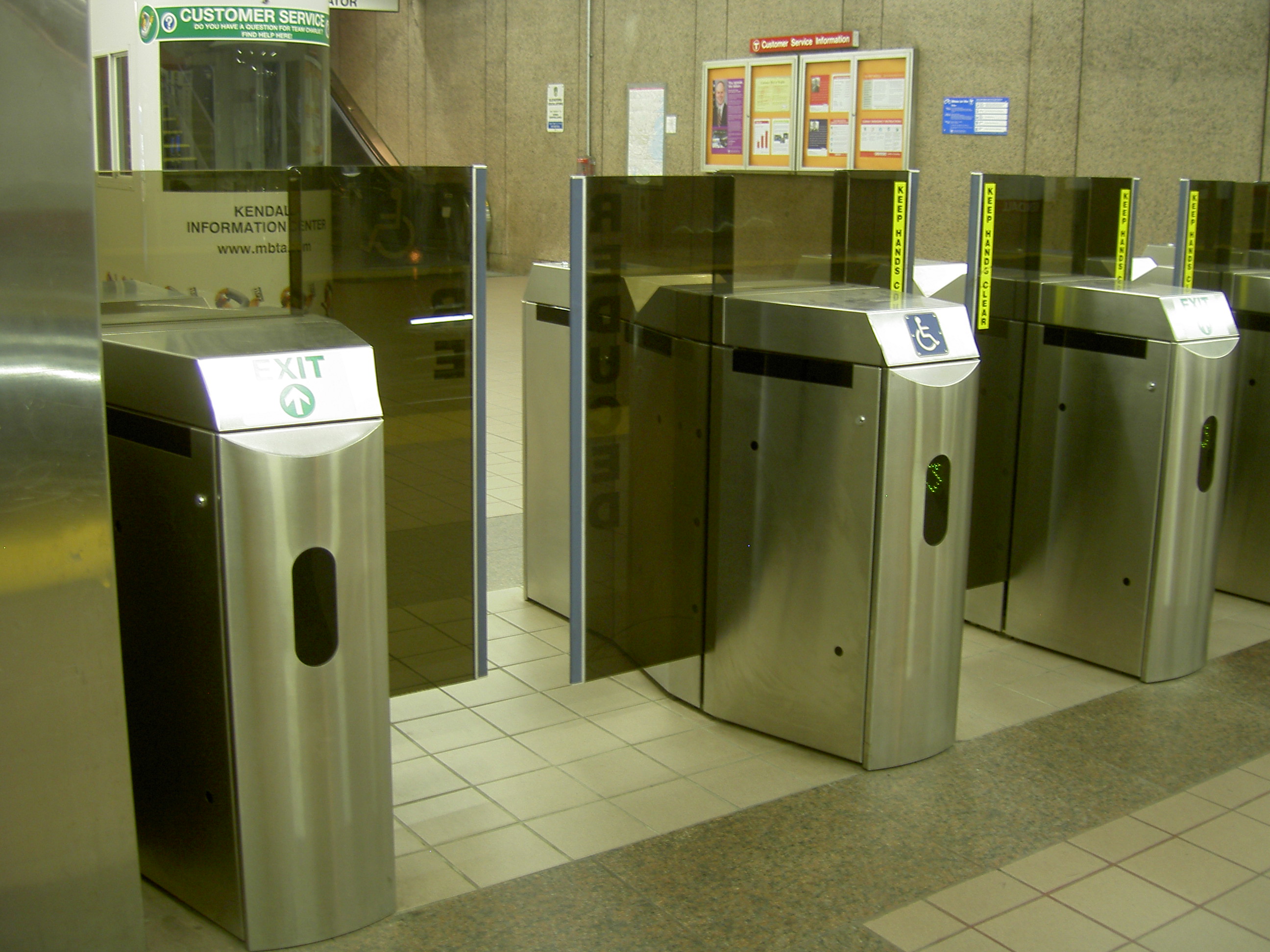
Fare gates at an MBTA station in Boston. (Dan4th Nicholas/Flickr)

As part of a new fare "control strategy", OC Transpo recommends the installation of fare barriers at Confederation Line and O-Train stations. In a report to be debated at the Transit Commission meeting next week, the implementation of fare-related equipment including fare gates, fare vending machines, and customer service communication posts, is estimated to cost between $20 and $25 million.

Physical fare barriers at O-Train stations, which are to be sheltered with "weather-protected enclosures", will be tested in 2016 before the Confederation Line opens. The decision between automated gates and turnstiles has not been made yet. The advantage to automated gates is that anyone can go through them including those who use wheelchairs or strollers.

In addition to acting as fare collectors, fare gates can be used for crowd control purposes like on Canada Day or during an emergency. The plan is to have them monitored and controlled by OC Transpo control centre. The remote ability to lock the gates is useful when there is an expected or unexpected service shutdown, for example. No one wants to pay their fare only to find out that train service isn't running.

With this method of fare collection, there is no need for POP (proof-of-payment) checkers on board any train. While it's not stated in the report, double-deckers and articulated buses will presumably continue to be inspected under the POP system.

Monday, December 2, 2013

Transitway stations get makeover in the form of "station domination"

If you travelled through Hurdman or Lincoln Fields Stations in November, you may have noticed the large Rogers Communications ads covering Transitway shelters and stairs. Pattison Outdoor Advertising, the agency in charge of managing ads on OC Transpo property, says the "station domination" ad campaign will end this week on December 3rd. (There's a photo of Hurdman Station blanketed in Rogers advertisements in the link.) Station domination gives a company exclusive advertising rights to a particular station for a limited time.

A passenger tweeted a photo of a set of stairs that shows the Rogers promotions at Lincoln Fields Station:


Last year, large lobsters were placed on top of bus stop shelters to promote P.E.I tourism. The conventional ads are the posters placed inside and outside buses, and on bus stop shelters. A single ad can wrap the entire exterior of buses. We are used to this on our transit system and wouldn't think twice. Now for the very first time in Ottawa, transit station shelters, walls, and floors can be covered in ads promoting the same message. Station domination is a common advertisement practice in subway and LRT stations across this country, but is generally met with public disapproval.

Some passengers may be annoyed with them, especially the telecom ones, while others may not noticed or simply don't care. When ads start to creep into areas that have remained ad-free, they usually don't go away. Station domination could appear in future Confederation Line stations, which will be far more spacious than the current Transitway stations and consequently, provide more opportunities to advertisers.

However, advertising on transit property is not a significant source of revenue for OC Transpo. Advertising on transit shelters and vehicles generates approximately $3.3 million per year, a relatively small amount compared to the $218.6 million revenue that the the transit agency estimates it will generate in 2014. It's roughly 1.5%. As for revenue from station domination, in 2011, the City projected it would bring $50,000 in revenue during the first year (2011) of implementation. It's nowhere near enough to stop annual fare hikes unfortunately.

Whether you like it or not, station domination is probably here to stay. There is concern about multiple ads of similarity interfering with wayfinding signage and confusing the casual user or tourist. And of course, station domination can turn a beautiful rail station into a marketing jungle. The first set of ads haven't created a public outcry, but it doesn't mean they are accepted either. Like the bus wraps, station domination should be applied sparingly.

Thursday, November 28, 2013

Does bike-sharing work?

National Post columnist Jesse Kline penned an intriguing article a couple weeks ago questioning the wisdom of municipalities investing in Bixi or Bixi-like bike-sharing systems. Although they've long been seen as a potentially valuable component of urban transit, it's hard to deny Kline's points throughout the article:
The best that can be said about the bureaucrats behind Bixi is that they’ve done a good job of selling the bike-sharing service to other cities. Indeed, the only profitable part of the company, which was later sold off in order to comply with Quebec law, was tasked with marketing the program abroad. Unfortunately, Montreal also has managed to export many of the problems that go along with the Bixi model.
[...]
Examples from other countries also provide cautionary tales. The Washington, D.C., bike-share system received $16-million in federal, state and local subsidies. This money was supposed to give disadvantaged people access to a low-cost mode of transportation, but one user survey found that it was almost exclusively used by affluent, well-educated people — hardly the demographic that needs taxpayer subsidies to get around town.
Although the City of Ottawa's prudent fiscal managers have so far resisted to give money to the system, the NCC has put forward a good deal of money (according to Kline, about $600k). It might be sensible to them, as it provides tourists with a low-cost way of travelling between local attractions, but little is known about adoption or usage rates.

On the surface, a large-scale Bixi system in partnership with OC Transpo could offer a good solution to the "last mile" conundrum of getting commuters to and from transit stations, but at what cost? It would certainly be more expensive than the current solution of having riders walk (or get a drive) to and fro.

Wednesday, November 27, 2013

OC Transpo must take real action on transit safety


A few months ago, in the aftermath of a horrific sexual assault that began at Blair Station, I wrote about how badly the inadequate response of OC Transpo was hammering the utility's public image. It's also negligently and unnecessarily putting more riders at risk, and recent e-mails revealed by the Ottawa Citizen suggest that it was a public relations strategy to downplay bad news and promote good news that influenced the decision:
When a young woman was attacked by four men at Blair station on Aug. 11 and then sexually assaulted in a nearby secluded area, the public demanded answers about transit safety. But instead of speaking to news media, Transpo staff refused to talk for more than a week until they could present their safety improvement plans at a public meeting.
That presentation was OC Transpo's ten-point safety plan, which included very little of substance. Although changing the Night-Stop program to begin at 7 p.m. is an actual tangible change, the others seem administrative things, including the development of "an inventory of best practices" and the encouragement of more assault reports to gather data on where they happen more often.

Is that really going to make riders safer? Or even make them feel safer?

And the feeling of safety is a big concern. In a recent column, Metro's Steve Collins spoke to one OC Transpo rider about why she stopped taking the bus, and a lack of safety was at the forefront of her concerns. That is important in terms of public safety, of course, but it's also important in light of the continuing decreases in ridership on OC Transpo.

Instead of trying to downplay the significance of bad-news stories, OC Transpo and the City of Ottawa needs to address the underlying issues of safety on and around its buses and stations. The onus shouldn't be on the assaulted to snap a photo of the assaulter, as happened in a 2012 case of assault on an OC Transpo bus. A safety audit might also be a good idea, but OC Transpo seems convinced that they don't need to do one--despite the fact that it's been nearly a decade since their last thorough audit.

There are lots of things OC Transpo and the City of Ottawa could do to improve safety. They could increase the presence of special constables and even police officers on and around transit stations. They could retrofit buses with video cameras, instead of simply having them installed on all future ones. They could appeal to organizations like Hollaback! Ottawa for ideas on what might improve the situation.

The last thing they should do is try to ignore it until it goes away, because it's an issue that's not going anywhere.

Wednesday, November 20, 2013

OC Transpo ridership down again, three-year lows expected for 2013

As reported in the Citizen and Sun last week, OC Transpo's ridership are down yet again for the third quarter of 2013. From the Citizen's coverage:
"According to newly released figures for July, August and September, OC Transpo gave 21.1 million rides in those months, down 3.9 per cent from the year before."
OC Transpo continues to place the blame on job cuts in the federal public service, although that seems like it's just their best guess--there are likely other factors that could be at play, including the introduction of Presto cards, the phasing out of EcoPasses, recent and continuing increases in bus fares, and construction-related transit delays.

The continued ridership decline means that OC Transpo is expecting to fall below 100 million rides for 2013, despite exceeding that number in 2012 (101 million) and 2011 (103.5 million). It's unclear at this point whether ridership will even match numbers from 2010 (99.3 million), which could mean this year will be the worst for OC Transpo since the 2008-09 winter transit strike.

No one wants to talk about that thing again...

Monday, November 11, 2013

Should pets be permitted on OC Transpo?


As reported in the Ottawa Sun, a group of people from the Ottawa Pet Expo have launched a Change.org petition to have OC Transpo initiate a pilot project to allow small pets in crates or carriers on buses during off-peak hours. From the petition's description:
The Ottawa Pet Expo petitions for a "Pets on Public Transit Policy" to be introduced as a six-month pilot project, allowing small pets in crates/carriers on public transit during off-peak hours. During this six-month pilot period, OC Transpo bus drivers will be given the discretion to refuse boarding to anyone with a crate that exceeds size restrictions, e.g. larger than can be carried and stored easily or a crate or carrier that appears insecure.
This isn't the first petition that's been circulated on this issue; back in 2008, the local chapter of the Responsible Dog Owners of Canada published a 2,000-signature petition to the same ends: A six-month pilot project that would allow pets on OC Transpo buses.

The current petition, however, backs up their request with statements of support from the Ottawa By-law and Regulatory Services Branch, the Ottawa Spay & Neuter Clinic, Ottawa Public Health, and the Ottawa Humane Society for a pilot project. Also, apparently there are 25 cities in Canada that allow pets on public transit, including Toronto, Vancouver, and Winnipeg.

Potential issues remain, however, and the one that stands out to me is the potential impact of this pilot project on a bus operator's ability to concentrate on his job. Allergies are a major issue; noise is another, but there's no shortage of noise on the bus most of the time so operators must be pretty used to that by now. The possibility of a pet escaping from the control of his or her human companion is another issue, of course; a dog or cat running around on the bus could create a very dangerous distraction for the operator.

Also, giving operators the discretion to refuse animals just opens the door for conflict--if an operator says no, the pet's human companion may not (and probably will not) react calmly. Operators take enough unwarranted abuse from riders and giving them discretion over such an issue opens the door for even more.

And, of course, animal crates take up space. That won't be as much of an issue during off-peak hours, but it could still cause problems.

On the other hand, regular transit users have pets that need to get to veterinarian appointments. If this pilot project moves forward, it will offer them the opportunity to get there by public transit, increasing the number of off-peak and non-commuting trips available to Ottawa residents.

So I put the question to readers: What are your thoughts on this pilot project?

Monday, October 21, 2013

OC Transpo plans to display important service news at top of website

OC Transpo will be moving some items around on their home page of OCTranspo.com. A message on their website states that news items will be more organized and service status messages will be placed at the top:

Early this week you will see a few changes to the octranspo.com homepage.
All of the same information you see there now will still be visible, but in a different order:
• A new “breaking news” panel will be available at the top of the page.
• Daily service status messages will also be prominently displayed at the top, in the centre.
• There will be more room to include images with each news item.
• All news items will be organized in one central column, instead of two columns.
• Upcoming events will be displayed on the right-hand column, one click away from the Quick Planner.

The OC Transpo website is very popular – it receives 15-20,000 visits each day. We didn’t want to tinker too much with success, but based on previous suggestions felt that these changes would be an improvement. Please let us know what you think – send your comments or ideas to ocadmin@octranspo.com.

A little thing like displaying important messages about service delays in a prominent spot on the website can significantly improve customer experience. As you may know, during any unexpected partial Transitway or O-Train closure, you'll usually see a message tucked away on the side in the smallest font size, which is how they are displayed right now. It's something we can easily miss on the home page.

OCTranspo.com


These changes refer to their main website only, but the mobile website deserves similar treatment too. Any important service updates should be on the main page of the mobile site without making the user click on another page to see if, for example, the transit system is an hour behind during a snowstorm.

OCTranspo.mobi

Tuesday, October 15, 2013

New bus on-ramp to 417 eastbound to open at Canadian Tire Centre

Bus riders leaving Canadian Tire Centre will finally have quicker access to the Queensway. Starting on Thursday after the Sens home-opener, the dedicated bus on-ramp to Highway 417 will be open, allowing the 400-series passengers to save about 15 minutes. Also on the same night, CTC will offer free parking, which will likely increase traffic and make the bus ramp an even greater benefit to transit users. When the project was first announced in July 2011, the idea was to give transit buses exiting the stop loop priority to the on-ramp first and to allow other HOV's access next.


Some people on Twitter complained about "Stage 2" of the proposed Transportation Master Plan draft, saying the western LRT extension should reach all the way to the Senators arena. There are a number of reasons for this to not happen. As mentioned earlier, the bus on-ramp was in the works for the past couple of years. The only real activity surrounding the rink occurs after large concerts and hockey games for about half an hour or so each night. And since there isn't much of anything nearby (employment, retail, residential spaces), a light-rail line serving the arena is unappealing for everyday use. Until the area becomes more than a place to watch hockey, the bus ramp will do just fine.