Showing posts with label Presto cards. Show all posts

Wednesday, June 15, 2016

Transit Commission approves LRT-ready fare table, including 9% regular pass hike

At their meeting on Wednesday, the City of Ottawa's Transit Commission approved OC Transpo's proposed fare table, which is to take effect on January 1, 2017 and prepare riders for the transition to light rail in 2018.

The proposed fare table, illustrated below along with existing fares and the changes that would accompany it, will go to full council on June 22. (Click the image to enlarge it.)

*Express fares are being eliminated, and express riders will pay regular fares as of Jan. 1
**The existing Student pass will be rebranded as a Youth pass

You will notice some massive reductions in the express fares and passes, which is because OC Transpo has proposed eliminating premium express fares even though it is expected that express buses will continue to run until LRT is online. The elimination of those premium fares would have resulted in a $6M revenue shortfall for OC Transpo, which is the main reason why regular passholders will see an increase of nearly nine percent over today's pass cost.

(Note: The overall increases illustrated above, if approved, will be implemented in two phases; there will be a 2.5% increase on July 1 that was part of the 2016 budget, and the rest will take effect on Jan. 1, 2017 if approved by council.)

Paper tickets will also be discontinued as of Jan. 1, 2017, meaning the only single-fare options are cash and Presto.

Regular riders will take a big hit on their fares if they buy a monthly pass, but those who pay-per-ride with their Presto card will take an even bigger hit: Regular Presto fares will go up more than 16 percent over today's cost.

Cash fares, on the other hand, are being REDUCED, to the point where they are barely more expensive than epurse fares. This seems like a strange choice given that a major motivator for OC Transpo switching to Presto was the additional handling costs associated with cash fares (which will now, presuming they're more than five cents per fare, be subsidized by other riders).

The biggest hit, though, will be to Daypasses, which are going up by over 20 percent to hit the $10 mark on Jan. 1. It's tough to know who this will impact specifically; although Daypasses are good for families taking weekend trips, they're not marketed very heavily and thus don't seem to be used very often. Right now the Daypass is slightly cheaper than three single fares in a day, but with the hike it will only make sense if you've got four rides planned in a day.

Wednesday's commission meeting also featured a lively discussion of the proposed Low-Income Transit Pass, which the Transit Commission wants the province to pay for. Proponents of the pass, however, argued against "passing the buck" to the provincial government and made proposals to fund it by increasing fares on the existing ridership base.

Monday, March 10, 2014

Where does unspent Presto Card money go?


An interesting story came out a few months ago in the New York Times, which revealed that New York's Metropolitan Transportation Authority (MTA) was able to claim over $500M of unspent balances on previously-purchased MetroCards:
Cards that are bought, never used but still valid are counted for bookkeeping purposes as a liability, because they might eventually be used. Outdated cards with pending balances become an asset after they expire, about two years from the date of sale. The balances are listed as revenue under the category of “fare media liability.”
Although Metrolinx (the Toronto-based provincial agency that manages Presto) isn't near the size of the MTA, there still must be the possibility that some amount of funds are occasionally left on Presto cards once they expire--which, for the record, happens after five years.

When this happens, where does this money go? Presumably it gets swallowed up into Metrolinx' bottom line, which doesn't seem fair for OC Transpo when it comes to money initially purchased for use in Ottawa. I'm not sure what happens, but it would be interesting to find out.

Sunday, December 8, 2013

Fare-paid zones proposed for major transfer stations

On Monday, the Transit Commission will be presented with the new fare strategy, proposed by OC Transpo, for Confederation and O-Train lines. The report suggests fare gates or turnstiles, fare vending machines, and electronic customer service boxes to be installed at rail station entrances.

As part of the fare plan, OC Transpo wants to implement fare-paid zones at major transfer and terminus stations. A fare-paid zone is an area where customers have already paid and are not required to further validate their fare in the station. The idea behind fare-paid zones is to make bus-rail connections as smooth as possible with minimal transfer delays for passengers. It means all-door boarding on buses, even on regular-sized 40-foot buses. Fare-paid zones are similar to the current POP areas at O-Train stations except that passengers won't be asked for proof of payment.

The proposed stations to have the fare-paid areas are Tunney's Pasture, Bayview, Greenboro, Hurdman, and Blair. A case could be made to include St. Laurent on that list since the station would already be designed to easily allow a fare-paid zone. The only pedestrian access on the upper level is the crosswalk to the shopping mall, which can controlled by fare barriers. Unless OC Transpo wants to keep the St. Laurent sales centre open, there's really no reason not to have a fare-paid zone.

For those walking off the street to take the bus at one of these stations, they will have to pay at a fare barrier before stepping onto a bus platform. When fare payments are being made outside the bus, in theory, boarding times should be reduced.

The City's concept diagram of the future Tunney's Pasture LRT station shows bus platforms as being part of the fare-paid zone:


There are a few other things to note about the proposed revamped fare system. The current time-based transfer system would still be applied to all rail stations. Barcodes on transfers are suggested to make transfers readable to fare machines. Presto cards will continue to be used. In the document, the City provides this quick-reference table on how each fare method will be used across the transit system:


Tuesday, December 3, 2013

Confederation Line & O-Train fare barriers to be tested in 2016

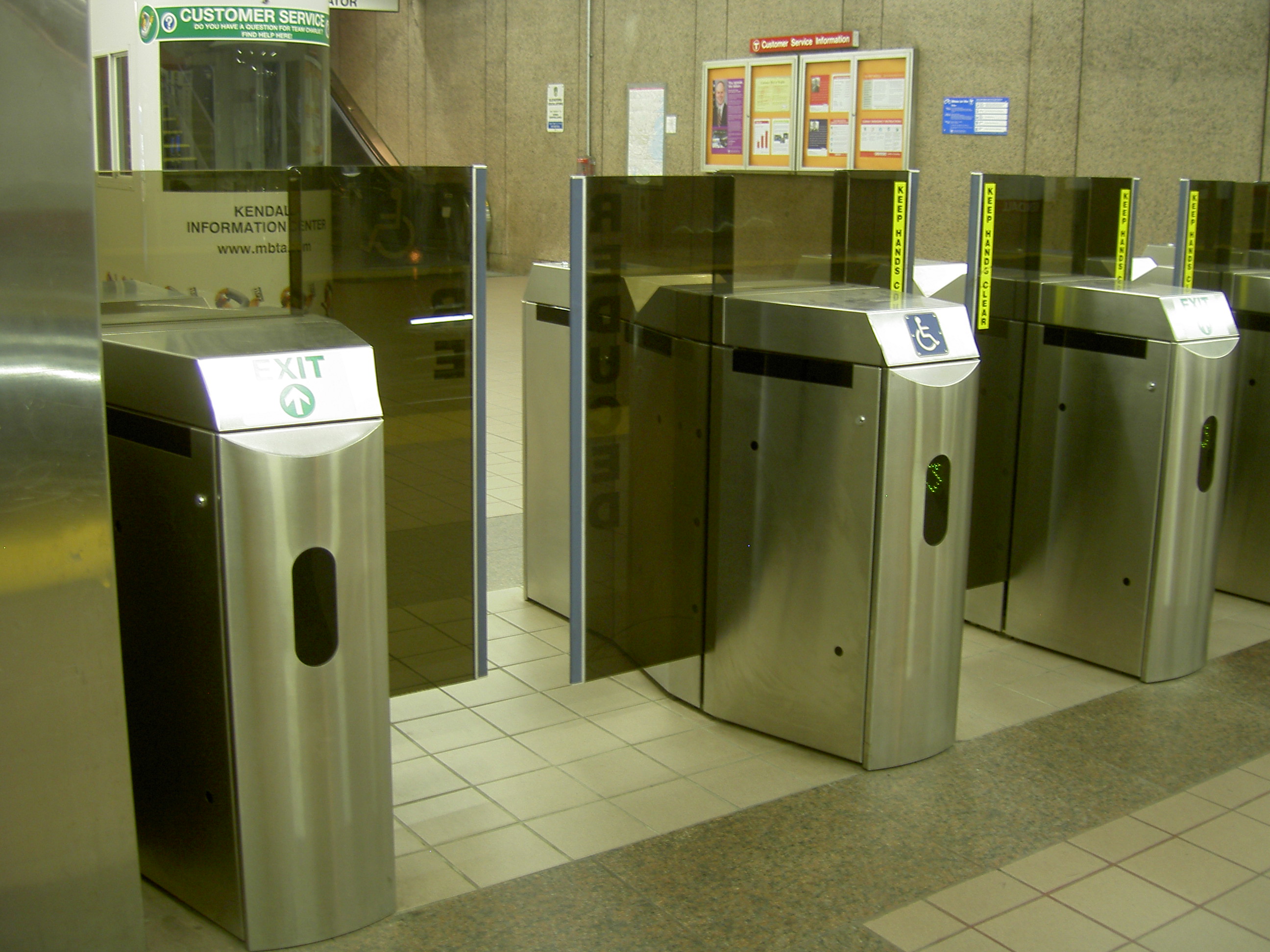
Fare gates at an MBTA station in Boston. (Dan4th Nicholas/Flickr)

As part of a new fare "control strategy", OC Transpo recommends the installation of fare barriers at Confederation Line and O-Train stations. In a report to be debated at the Transit Commission meeting next week, the implementation of fare-related equipment including fare gates, fare vending machines, and customer service communication posts, is estimated to cost between $20 and $25 million.

Physical fare barriers at O-Train stations, which are to be sheltered with "weather-protected enclosures", will be tested in 2016 before the Confederation Line opens. The decision between automated gates and turnstiles has not been made yet. The advantage to automated gates is that anyone can go through them including those who use wheelchairs or strollers.

In addition to acting as fare collectors, fare gates can be used for crowd control purposes like on Canada Day or during an emergency. The plan is to have them monitored and controlled by OC Transpo control centre. The remote ability to lock the gates is useful when there is an expected or unexpected service shutdown, for example. No one wants to pay their fare only to find out that train service isn't running.

With this method of fare collection, there is no need for POP (proof-of-payment) checkers on board any train. While it's not stated in the report, double-deckers and articulated buses will presumably continue to be inspected under the POP system.

Friday, November 22, 2013

OC Transpo fares to increase 1.9 per cent in 2014

The annual tradition of fare increases will continue in 2014, as yesterday the Transit Commission approved a budget that will see user fees for OC Transpo go up by an average of 1.9 per cent on July 1, 2014.

Hey, it's better than the 7.5 per cent increase that riders saw in March of 2010--in fact, OC Transpo General Manager John Manconi claims it's the smallest increase of OC Transpo fares in nine years:
Courtesy of the Ottawa Sun's Jonathan Willing, here's the full rate card:
I think my favourite is the new DayPass charge of $8.10... so utterly inconveniently random. Most people will probably just drop $8 in there, but I'd wager that shortfall will be made up for when people inevitably round up the $3.45 regular cash fare.

Presto fares, for the record, will be going up five cents to $2.77 per trip.

The most significant increase is the 16.4 per cent hike in community passes, from $35 to $40.75 per month. Those passes are designed for "Ottawa residents who receive benefits under the Ontario Disability Support Program (ODSP)" and registered Para Transpo customers.

It's an obvious reality that as costs of public transit increase, the costs to use public transit will also increase. But that doesn't make fare increases any more palatable.

Wednesday, November 20, 2013

OC Transpo ridership down again, three-year lows expected for 2013

As reported in the Citizen and Sun last week, OC Transpo's ridership are down yet again for the third quarter of 2013. From the Citizen's coverage:
"According to newly released figures for July, August and September, OC Transpo gave 21.1 million rides in those months, down 3.9 per cent from the year before."
OC Transpo continues to place the blame on job cuts in the federal public service, although that seems like it's just their best guess--there are likely other factors that could be at play, including the introduction of Presto cards, the phasing out of EcoPasses, recent and continuing increases in bus fares, and construction-related transit delays.

The continued ridership decline means that OC Transpo is expecting to fall below 100 million rides for 2013, despite exceeding that number in 2012 (101 million) and 2011 (103.5 million). It's unclear at this point whether ridership will even match numbers from 2010 (99.3 million), which could mean this year will be the worst for OC Transpo since the 2008-09 winter transit strike.

No one wants to talk about that thing again...

Tuesday, October 8, 2013

Rideau sales and info centre to move within mall

Update (October 16, 2:35pm): In a Transit Commission meeting on October 16, OC Transpo manager of business and operational service confirmed that the kiosk will have to move because Nordstrom wants their current space.

OC Transpo's Rideau Centre sales and information kiosk will move to across mall's guest service centre on the same level. They are moving at “the end of October.” As you may know, behind the current sales centre, the former Sears space is under construction.

For paper passes and tickets, the closest outlets near Mackenzie King Bridge are the following according to OC Transpo's website:


For Presto users, the Rideau Centre is still the only place in downtown to load the smart card or check its balance.

Monday, January 30, 2012

In the Year 2012: Presto Cards


Last Thursday, OC Transpo General Manager Alain Mercier presented the 2012 Business Plan to the Transit Commission. The 36-page document can be found here. Over the course of this week, we will look at this plan and pick out the highlights. Everything from operating costs to park and rides will be discussed.First, let's take a look at Presto.

As many of you are aware, Presto cards will be launching later this year to replace paper tickets and passes. These cards are transferable between anyone in the same fare group. For example, if you pay student fare, you may give your Presto card to another person who also pays the student fare – of course, you can't be on the bus or O-Train at the same time.

Another benefit with Presto is the different methods of payments you can choose to reload your card: internet, phone, mail, or in person. This should reduce the lengthy line-ups for passes each month. There is also an option to have your pass automatically purchased for the next month, which is adds to the convenience.

OC Transpo wants to simplify the system to two types of fares for students, adults, and seniors: single trip fares (similar to the existing ticket for less frequent travellers) and monthly passes. Since Presto does not use paper transfers, it might be difficult for most people to remember how much time is left on their single-fare.  The plan does not go into the specifics of how the whole fare system will be implemented. However, it might best for OC Transpo to install balance checkers at each Transitway station, on buses, and the O-Train.

Express fares will remain for express routes and the Day Pass, Family Pass, and U-Pass will continue. But, semester passes will be discontinued and the annual passes have stopped since December of last year. There was no mention of children's fare in the report but, it would make sense to have a fare for children, 6-11 years old, as they always have.

More on Presto can be found on OC Transpo's site and on Presto's site.

Friday, October 21, 2011

Is OC Transpo's fare structure too complicated?

Is OC Transpo's fare structure too complicated? Officials at OC Transpo believe so. As part of the Presto smartcard program, which is slated to launch in the spring or summer of 2012, OC Transpo also wants to revamp the entire fare structure.

The current fare structure may be complicated to tourists and first time users, but it is still easy to learn. A regular transit user in Ottawa isn't still trying to learn the fare system, which haven't drastically changed in at least 15 years. While not difficult to understand, the strangest OC Transpo fare category is the O-Train fare. It is more expensive than the regular fare of two tickets. This means that it is cheaper to pay two tickets on a bus and use a bus transfer for the O-Train than it is to buy an O-Train ticket and use it as a transfer on a bus. There are no separate fares for rail vehicles or subways in Toronto, Calgary, Montreal, Edmonton, and Vancouver, so why does Ottawa have a distinct rail fare category?

Apparently, the new fares will be more simple and equitable. For simplicity, one would think that express fares would be gone, but that likely will not occur because that would lead to a trunk and feeder system, which has been scraped until the new LRT begins operation. Maybe, it's the actual fare itself that will make it easier. Presto cards handle all types of fares including passes. If you don't know whether to put in two tickets or three, Presto should be able to make that decision for you.

As for making this more equitable, age related fares already exist. So, the only other equitable issue is the travel distance and this issue is partially solved by express fares.

Transit fares in Ottawa aren't much more complicated than other Canadian cities. Calgary and Montreal's fare system is a bit more simple since they do not use "express" service to the suburbs. Toronto has a few express routes from downtown to residential areas, which require a separate fare similar to ours. Vancouver uses zone fares, which could be confusing if you are a tourist. Your fare would cost more if you were to travel through multiple zones in Vancouver.

With the new Presto card, it is understandable that OC Transpo may have to make some changes to its current fare system. But, if the issue is the complexity of present fare system, we should have seen a revamped fare structure many years ago.

Monday, September 26, 2011

Transit Commission: OC Transpo added articulated buses and trips since September 4

Much was discussed on last Wednesday's Transit Commission meeting including the recent route changes/cuts/optimization, MacKenzie King Bridge congestion, and Presto smart cards. Here is the recap of that meeting (most of the information is referred to David Reevely's Twitter feed):
  • Six new trains for the O-Train were purchased for $35 million from Alstom and are scheduled to be in service in 2014. The purchase is in anticipation of the O-Train expanding to Leitrim, which will be assessed by consultants for its feasibility.
  • OC Transpo usually runs 175-178 buses on Slater during the PM rush according to OC Transpo Transit Design Manager Pat Scrimgeour. While Slater is close to threshold of 180, it is already experiencing significant bus congestion. From experience, walking from Metcalfe to Mackenzie King Bridge during the PM peak period is faster than riding any bus on Slater.
  • Regarding Mackenzie King Bridge, Scrimgeour says boarding and unloading is the issue, and not the pedistrian crossing. They are paying close attention to it. Last week, I saw what appeared to be OC Transpo supervisors assisting with closing the rear doors on the eastbound platform of Mackenzie King during the PM rush. I've witnessed this new procedure on two separate days at 5 p.m. and there hasn't been a noticeable improvement; buses were still backed up to Elgin.
  • OC Transpo ridership grew from August 2010 to August 2011 by 6.3%. Increased ridership and decreased service lead to overcrowded buses as experienced by many in September.
  • Maintenace Chief Larry Atkinson said around 30 routes per day are served by the wrong kind of bus. This is a high number, but it's possible that there was only one instance of that occurring for each route.
  • Since the route changes on September 4, OC Transpo has added articulated buses on certain trips on routes 4, 30, 34, 38, 41, 87, 93, 130, 134 and added trips during peak hours to routes 30, 131, 134, 136, 106. (Metro News)
  • Presto Cards are scheduled for April 2012. The smartcards will replace passes and tickets. In theory, there should be fewer lineups at pass retailers near the beginning of the month. While the program will cost Ottawa $25 million and the province $7 million, this is expected to cut costs on administration for tickets and passes. The city has discussed the idea for Presto since 2006.
  • Finally, Route 106 will serve the ring road around the General Hospital campus in late December. After continually modifying transit service to this area in the past month, it seems that Route 106 will be fully re-instated and operate like it did pre-September 4.