Showing posts with label O-Train. Show all posts

Thursday, September 11, 2014

Name that line

2018 O-Train system

Update (September 17): At the Transit Commission meeting today, OC Transpo confirmed the line colours on the map will be used in wayfinding signage (via the Ottawa Sun):

The Confederation Line will apply to the east-west LRT currently under construction. It will also be referred to as the 1 Line and have red wayfinding signs.

The Trillium Line will become the existing north-south diesel train service (currently called the O-Train). It will be referred to as the 2 Line and wayfinding signs will be green.

There are only two lines, but an early adoption of a numeric system for public use is a good idea. One, the public may very well refer to the lines by their numeric names for simplicity. And two , when there are more lines in the future, it's a bit of a challenge to number them many years later, which was exactly what the TTC in Toronto did this year, and have the public learn what number is associated with which line. 

OC Transpo is currently using red and green to identify bus routes as regular fare peak-hour and premium fare "express" peak-hour, respectively. To distinguish the modes of transit services from each other, different colours may be needed for the rush-hour bus services. Red and green signs inside rail stations with bus connections are not particularly useful if the rush-hour bus service continues to use the same colour scheme.


OC Transpo's rail system in 2018 will be called "O-Train", according to a report to the Transit Commission. The two rail lines in the network will also have names. The report recommends that the project name "Confederation Line" to also be the name of the east-west line and "Trillium Line" to replace "O-Train" as the name for the existing north-south route. Currently, the "O-Train" name is typically used to identify the type of transit vehicle, rather than the rapid transit line.

The "Confederation Line" name seems to have had the public's support from the very beginning. One has to wonder if this was the name all along and it was floated out before construction started to see how the public would react to it.

Labeling lines with names is supposed to minimize confusion among passengers. Interestingly, the 2018 map of the rail system above shows the "Confederation" station name on the exiting north-south line. Confederation station on the Trillium Line is not a stop to transfer to the Confederation Line, but the stop name implies it does. A different name is needed.

The report states the new name of the north-south line has to be easy to read, pronounce in both English and French, and be clear and unambiguous. After city staff reviewed some candidates for the new name, they decided "Trillium Line" fit the bill. "Trillium Line" will be introduced into the OC Transpo lexicon sometime within the next four years.

In addition to the name identities, the map of the 2018 O-Train system labels the lines by number and colour. The presence of the number names on the map may be a hint that red 1's and green 2's will appear on other customer information such as wayfinding signage at stations, especially at Bayview, the only station where the two lines meet. On the other hand, there are still four years away from the opening of a second line, so the numbering system may turn out to be nothing more than an idea.

Sunday, December 8, 2013

Fare-paid zones proposed for major transfer stations

On Monday, the Transit Commission will be presented with the new fare strategy, proposed by OC Transpo, for Confederation and O-Train lines. The report suggests fare gates or turnstiles, fare vending machines, and electronic customer service boxes to be installed at rail station entrances.

As part of the fare plan, OC Transpo wants to implement fare-paid zones at major transfer and terminus stations. A fare-paid zone is an area where customers have already paid and are not required to further validate their fare in the station. The idea behind fare-paid zones is to make bus-rail connections as smooth as possible with minimal transfer delays for passengers. It means all-door boarding on buses, even on regular-sized 40-foot buses. Fare-paid zones are similar to the current POP areas at O-Train stations except that passengers won't be asked for proof of payment.

The proposed stations to have the fare-paid areas are Tunney's Pasture, Bayview, Greenboro, Hurdman, and Blair. A case could be made to include St. Laurent on that list since the station would already be designed to easily allow a fare-paid zone. The only pedestrian access on the upper level is the crosswalk to the shopping mall, which can controlled by fare barriers. Unless OC Transpo wants to keep the St. Laurent sales centre open, there's really no reason not to have a fare-paid zone.

For those walking off the street to take the bus at one of these stations, they will have to pay at a fare barrier before stepping onto a bus platform. When fare payments are being made outside the bus, in theory, boarding times should be reduced.

The City's concept diagram of the future Tunney's Pasture LRT station shows bus platforms as being part of the fare-paid zone:


There are a few other things to note about the proposed revamped fare system. The current time-based transfer system would still be applied to all rail stations. Barcodes on transfers are suggested to make transfers readable to fare machines. Presto cards will continue to be used. In the document, the City provides this quick-reference table on how each fare method will be used across the transit system:


Thursday, December 5, 2013

Fare vending machines recommended at rail stations

A fare machine at a Skytrain station in Vancouver (Dan Udey/Flickr)


Earlier in the week, a City document submitted to the Transit Commission stated that fare barriers are recommended to be installed at O-Train and Confederation Line stations, starting in 2016. Other fare-related machinery, such fare vending machines and audio-visual communication posts linking to customer service representatives, are also proposed at the same rail stations, the report says.

Fare vending machines, to be placed near the fare barriers, will handle a number of transactions including the purchase of single-ride tickets, Presto monthly passes (hopefully, it can be used instantly), "companion fare", multiple-ride tickets, day passes, and "multiple-day" passes. The multi-day pass appears to be a new type of fare. It will certainly benefit tourists visiting for the weekend or staying for week(s) during events like Bluesfest or Winterlude.

The machines, which will handle cash, credit, debit, and Presto cards, have the ability to issue a Presto card and refill its e-purse. Each station entrance will have at least two fare vending machines. Parliament Station is proposed to have eight of them, the most out of all the O-Train and Confederation Line stations.

Displaying transfer times and e-purse balances on vending machine screens was not stated in the document. There should be an entirely different machine, maybe Presto specific, that simply displays this information. One can only hope.

If there is a fare-related issue, OC Transpo wants light-rail customers to use "customer help points", which are audio-visual communication posts that link to customer service representatives, located outside the fare-paid area. Due to higher operating and capital costs, face-to-face customer service from collector booths is not recommended in the plan. You have to wonder what this means for the future of the St. Laurent sales centre on the upper level.

The idea of fare vending machines being available at each Confederation Line and O-Train station must be a relief to those who wait in lengthy line-ups at the Rideau Centre.

Tuesday, December 3, 2013

Confederation Line & O-Train fare barriers to be tested in 2016

Fare gates at an MBTA station in Boston. (Dan4th Nicholas/Flickr)

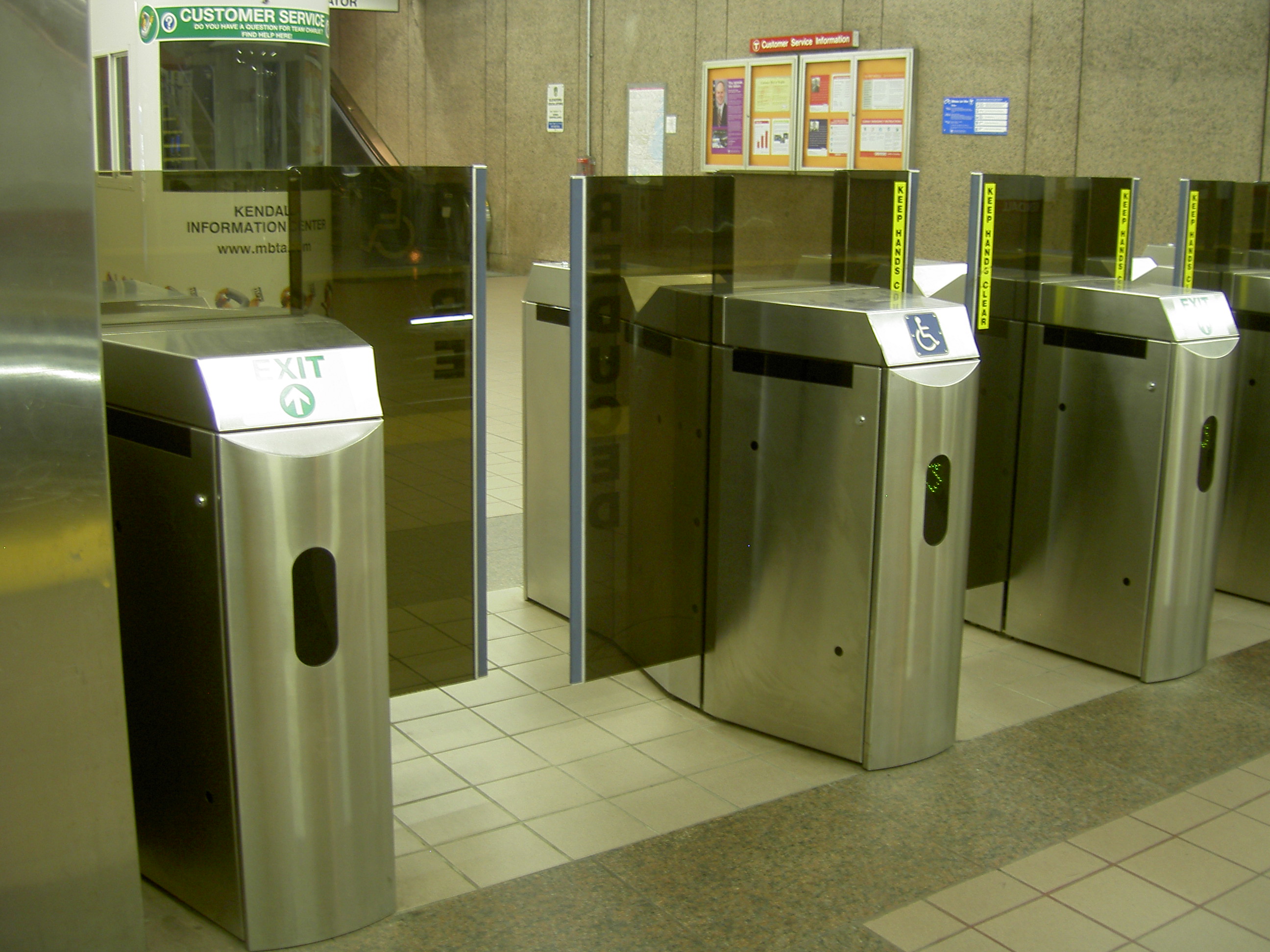
As part of a new fare "control strategy", OC Transpo recommends the installation of fare barriers at Confederation Line and O-Train stations. In a report to be debated at the Transit Commission meeting next week, the implementation of fare-related equipment including fare gates, fare vending machines, and customer service communication posts, is estimated to cost between $20 and $25 million.

Physical fare barriers at O-Train stations, which are to be sheltered with "weather-protected enclosures", will be tested in 2016 before the Confederation Line opens. The decision between automated gates and turnstiles has not been made yet. The advantage to automated gates is that anyone can go through them including those who use wheelchairs or strollers.

In addition to acting as fare collectors, fare gates can be used for crowd control purposes like on Canada Day or during an emergency. The plan is to have them monitored and controlled by OC Transpo control centre. The remote ability to lock the gates is useful when there is an expected or unexpected service shutdown, for example. No one wants to pay their fare only to find out that train service isn't running.

With this method of fare collection, there is no need for POP (proof-of-payment) checkers on board any train. While it's not stated in the report, double-deckers and articulated buses will presumably continue to be inspected under the POP system.

Thursday, October 10, 2013

Transit corridors that are no longer considered priorities

The newly proposed light-rail projects, named "Stage 2", in the 2013 Transportation Master Plan draft lead the transit discussion. To make room for these new initiatives, some project ideas in 2008 had to be dropped from the plan or moved beyond 2031. A comparison between the 2013 and 2008 maps will determine which transit corridors are no longer a priority.

Current 2013 proposed 2031 "affordable" transit network map:


From 2008, the 2031 transit network map:


(The links above open full-sized maps in PDF format.)

In Orleans, the Cumberland Transitway doesn't seem to be a priority anymore with the newly proposed Confederation Line extension into the eastern suburb. In 2008, the plan for Orleans was to have two busways, one grade separated along Regional Road 174 and one along Innes, both to Trim Road. Five years later, the new plan is to have light-rail extended from Blair to Place D'Orleans along Highway 174 and transit priority measurements (bus lanes, transit signal priority at intersections) on Innes Rd, Blackburn Bypass, and Brian Coburn Blvd.

The Innes Road/Industrial Avenue BRT, west of Orleans, from the 2008 plan is completely removed from this year's draft. The busway would have been parallel to the Confederation LRT Line, acting as a secondary east-west rapid transit corridor.

While the O-Train line is still planned to be extended to Bowesville, it will no longer reach Limebank as envisioned in 2008 and a rail link to the Ottawa International Airport has been removed too. Improved transit service to and from the airport is expected to happen by 2031 when HOV lanes are implemented on the Airport Parkway.

Heron/Walkley/Russell/St. Laurent was once a suggested route for bus lanes, but that's been removed from the current draft plan. St. Laurent Blvd will instead receive transit priority signals and queue jump lanes at some intersections.

Carling Avenue will no longer be a priority for rail of any kind and instead, bus lanes will be in place from the O-Train station to Lincoln Fields Station. There was a lot of discussion about Carling Avenue as an alternative route to the Sir John A. MacDonald Parkway for light rail. Or perhaps, the corridor would be served by a tram or streetcar of some sort with more local stops. For the next two decades though, it's strictly buses.

A Transitway linking Baseline Station to the Barrhaven Transitway will have to wait after 2031.

In Barrhaven, the Transitway was supposed to get an extension southwards eventually from Barrhaven Centre to Cambrian and another one eastwards along Chapman Mills across the Strandherd-Armstrong bridge, which isn't complete yet, to the previously proposed terminus of the O-Train line at Limebank Road. That was the idea five years ago and today, the plan is to have a combination of bus lanes and other transit priority measures on the same east-west route connecting Barrhaven with Riverside South.

The Kanata North Transitway will no longer be constructed northwards to Maxwell Bridge and instead, it will end at Carling Avenue. The Kanata Transitway, which was planned to run north along Highway 417 from Moodie to Huntmar and dip south between Stittsville and Kanata to Fernbank Road, is removed entirely from the 2013 plan. There are no transit priority measures of any kind in place of it.

Many transit initiatives planned to be implemented by 2031

On Wednesday morning, Mayor Watson announced the City of Ottawa’s proposed transit network plan which includes the eastern extension of the Confederation Line to Place D’Orleans, western extension to Bayshore, southern extension of the O-Train line to Bowesville, all at a cost of $2.5 billion and to be completed by 2023. 

Although there doesn't seem to be any timeline attached to each project, the costs of the proposed light-rail projects were revealed in the updated TMP draft (page 38 on document, 42 on Adobe Reader):

  • O-Train southern extension from Greenboro Station to Bowesville with new stations at Gladstone, Walkley, South Keys, Leitrim, and Bowesville: $99 million. No station or connection is planned at the Airport.
  • Western LRT extension of the Confederation Line from Tunney’s Pasture to Baseline Road along existing Transitway corridor: $980 million. This proposed project was already being discussed at city hall well before the updated TMP.
  • Western LRT extension from Lincoln Fields to Bayshore in a tunnel underneath Connaught Avenue: $396 million.
  • Eastern LRT extension of the Confederation Line from Blair Station to Place D’Orleans: $500 million.
These figures are in 2013 dollars. So, in a few years, the prices of these projects will probably increase with inflation.

Buried in the draft of the Transportation Master Plan are some non-LRT transit initiatives. Here are the "affordable" BRT ones that can be implemented by 2031: 
  • Western Transitway extension from Bayshore to west of Moodie Drive will run along Highway 417 with one station near Moodie Drive. This busway, from the original TMP of 2008, is priced at $79 million.
  • Bus-rapid transit (BRT) along Baseline Road from Heron to Baseline Stations. This is a new BRT line to be constructed on the existing road with at-grade intersections and is priced at $131 million.
  • A Kanata North at-grade BRT Transitway will follow March Road, connecting Highway 417 to Carling Avenue. Kanata’s first busway will cost $110 million. This western busway was also in the 2008 TMP.

According to the next page, the number of Airport Parkway lanes will double from two to four from Hunt Club to the MacDonald-Cartier International Airport. The new lanes will become HOV lanes, but buses can only use the lanes during peak periods. The expansion is scheduled for construction between 2026 and 2031, as per the appendix.

Further down the same page, the draft of the TMP also lists some roads that can potentially feature new bus lanes:

  • Carling Avenue from the Carling O-Train Station to Lincoln Fields Station. It’s currently being served by routes 6, 16, 85, 101, 102.
  • Hemlock Road & Codd’s Road from St. Laurent Boulevard to Montreal Road. There is currently no service on these sections of roads.
  • Hunt Club Road from Albion Road to Uplands Drive. It’s currently being served by routes 1, 87, 98, 114, 116, 143, 146, 147, 189, 199.
  • Montreal Road from St Laurent to Blair Road.  It’s currently being served by route 12. The hours of the existing priority lanes form Cummings Bridge to St Laurent Blvd are to be extended.
  • Blackburn Bypass peak period lanes.
 
Here are some streets that are supposed to have both queue jump lanes and transit signal priority at selected intersections in the future:
  • Baseline Road from Baseline Station to Bayshore Station, currently served by (The plan says “Bayshore” and there’s no existing bus route that connects Baseline Station to Bayshore.) It’s currently being served by route 118.
  • Carling Avenue from Bronson Avenue to Carling O-Train Station. It’s currently being served by routes 6, 85, 101, 102.
  • Chapman Mills / Strandherd / Earl Armstrong from Barrhaven Centre to proposed Bowesville O-Train Station. Chapman Mills and Strandherd are supposed to be served by routes 94, 95 once the Strandherd-Armstrong bridge is completed.
  • Eagleson Road from Hazeldean Road to Highway 417. It’s currently being served by routes 96, 61, 62, 164, 168.
  • Hazeldean Road from Stittsville Main Street to Eagleson Road. It’s currently being served by routes 96, 118.
  • Innes Road and Blair Road from Millennium Station to Blair Station. It’s currently being served by routes 94, 121. 126, 128, 131.
  • Jeanne D’Arc Boulevard from Innes Road to Jeanne D’Arc Station. It’s currently being served by routes 30/130, 31/131, 132.
  • March Road from Carling Avenue to Maxwell Bridge Road. It’s currently being served by route 60.
  • Merivale Road from Baseline Road to Carling Avenue. It’s currently being served by routes 14, 151, 176.
  • Orleans Boulevard from Jeanne D’Arc Boulevard South to proposed Orleans Blvd LRT Station. It’s currently being served by routes 34/134, 132.
  • Richmond Road / Wellington Street West / Somerset Street from Woodroffe Avenue to Bank Street. It’s currently being served by route 2.
  • Robertson Road and Richmond Road from Eagleson Road to Baseline Road. It’s currently being served by routes 118, 97.
  • St Laurent Boulevard from Innes Road to Montreal Road. It’s currently being served by routes 114, 5, 7, 14.
  • Tenth Line Road from Charlemagne Boulevard to Regional Road 174. It’s currently being served by route 136.

To be clear, these transit initiatives are considered to be "affordable" and can be implemented by 2031. BRT projects are supposed to cost $317 million, while the transit priority projects (bus lanes, transit signal priority, etc) are estimated at $200 million, bringing the total cost to just under $3 billion.

Wednesday, October 9, 2013

Proposed transportation plan features light rail extensions to be completed by 2023


Mayor Jim Watson announced the City of Ottawa's proposed Transportation Master Plan this morning, and the ambitious plan includes light-rail extensions to Baseline, Bayshore, and Place D'Orleans, plus conversion of the O-Train to light-rail before adding in new stations on the current line and then extending the whole thing to Bowesville -- all happening concurrently, all finished before 2023, at a price tag of about $2.5B.

Here are the details of the mayor's speech from various city hall reporters and the mayor himself:


Not sure what that entails. It could mean better bus service connecting to the Confederation Line, since the college is not considered within walking distance from either Cyrville or Blair Station.


The new busways in the west are nothing new. Kanata North will likely see more reliable and less travel times for route 93 once the busway opens.

These "new bus measures in the east along Blair" are probably for route 94. Innes was mentioned as one of the "transit priority" roads in the city's media release. The others are Montreal Road, Hunt Club Road, Carling Avenue, and Bank Street. Transit priority usually means an adjustment of the traffic lights to minimize delays to transit vehicles.


The Airport Parkway will be expanded to four lanes total. The HOV lane will certainly improve service on the 97 route. Creating dedicated lanes act as an alternative to extending the O-Train to the airport. (As you'll see later, the O-Train line extends south of the airport, but doesn't connect to it.)


This benefits transit users in that area too because they'll now have access to either routes 16 or 18.


Plenty of discussion about the Richmond Underground already.


One of the proposed light-rail extensions is from Lincoln Fields to Bayshore Shopping Centre and here's how it's supposed to look:

So, it appears the Pinecrest-Bayshore busway, where routes 93 and 96 travel, will be converted into light-rail.


The O-Train south extension:
Interesting how there's an LRT extension to a rural area, but not to the airport. The additional ridership from the added stations and line extension can't be supported from the existing single track sections of the line. It would have to be expanded entirely to double-tracking eventually.

The new stations in the south will take some pressure off buses on the south-east Transitway, which is likely the goal here. To the north, the Gladstone O-Train station is a welcome addition.


Orleans LRT extension:

Most of the 95 bus line will be replaced in the east end and Orleans Boulevard Station will be a new station since there isn't an existing BRT one at the moment. One thing to note is the rail line will extend through the Greenbelt on NCC land, which is not something the crown corporation will easily give up.


This is supposed to be one large project, both physically and financially:


Hard to imagine all rail extensions would be constructed simultaneously within ten years, given that both federal and provincial governments are experiencing enormous budget deficits.


The new bold LRT plan is called "Stage 2":


The draft outline of the Transportation Master Plan can be seen on the city's website and further details are to be released later this afternoon by the city. The plan will be debated at a Transit Commission meeting next week, and at a Transportation Commission and City Council meetings in November.

Monday, September 26, 2011

Transit Commission: OC Transpo added articulated buses and trips since September 4

Much was discussed on last Wednesday's Transit Commission meeting including the recent route changes/cuts/optimization, MacKenzie King Bridge congestion, and Presto smart cards. Here is the recap of that meeting (most of the information is referred to David Reevely's Twitter feed):
  • Six new trains for the O-Train were purchased for $35 million from Alstom and are scheduled to be in service in 2014. The purchase is in anticipation of the O-Train expanding to Leitrim, which will be assessed by consultants for its feasibility.
  • OC Transpo usually runs 175-178 buses on Slater during the PM rush according to OC Transpo Transit Design Manager Pat Scrimgeour. While Slater is close to threshold of 180, it is already experiencing significant bus congestion. From experience, walking from Metcalfe to Mackenzie King Bridge during the PM peak period is faster than riding any bus on Slater.
  • Regarding Mackenzie King Bridge, Scrimgeour says boarding and unloading is the issue, and not the pedistrian crossing. They are paying close attention to it. Last week, I saw what appeared to be OC Transpo supervisors assisting with closing the rear doors on the eastbound platform of Mackenzie King during the PM rush. I've witnessed this new procedure on two separate days at 5 p.m. and there hasn't been a noticeable improvement; buses were still backed up to Elgin.
  • OC Transpo ridership grew from August 2010 to August 2011 by 6.3%. Increased ridership and decreased service lead to overcrowded buses as experienced by many in September.
  • Maintenace Chief Larry Atkinson said around 30 routes per day are served by the wrong kind of bus. This is a high number, but it's possible that there was only one instance of that occurring for each route.
  • Since the route changes on September 4, OC Transpo has added articulated buses on certain trips on routes 4, 30, 34, 38, 41, 87, 93, 130, 134 and added trips during peak hours to routes 30, 131, 134, 136, 106. (Metro News)
  • Presto Cards are scheduled for April 2012. The smartcards will replace passes and tickets. In theory, there should be fewer lineups at pass retailers near the beginning of the month. While the program will cost Ottawa $25 million and the province $7 million, this is expected to cut costs on administration for tickets and passes. The city has discussed the idea for Presto since 2006.
  • Finally, Route 106 will serve the ring road around the General Hospital campus in late December. After continually modifying transit service to this area in the past month, it seems that Route 106 will be fully re-instated and operate like it did pre-September 4.

Wednesday, July 20, 2011

Some people really like the O-Train

This is downright hilarious. A rock video homage to Ottawa's O-Train:


It looks like the video is a production of Pratt Media Studios, featuring a performance of the song by local musical act GOOD2GO, recorded for a class of some sort. Whatever it was for, it's pretty great.

My favourite lyric: "Why spend our time on a broken down 95/hundred drunks inside?" Especially because the video would have required the cooperation of OC Transpo themselves.

Friday, May 27, 2011

Transit issues on Talk Ottawa

On Thursday evening's Talk Ottawa program, public transit dominated much of a program that was about municipal issues in general. Along with myself (Peter Raaymakers), the panel included Peggy DuCharme, executive director of the Downtown Rideau Business Improvement Agency, and David Reevely, News Editor and blogger for the Ottawa Citizen talked about a variety of issues in our city today.

The roundtable kicked things off with a discussion of several issues facing the city's current light-rail transit plan, and especially the downtown tunnel. As is usually the case, cost came up, and the possibility (or probability) of cost increases as we move forward with the plan. The general consensus of the panel was that costs will likely go up, at the very least due to inflation, but that's a fairly normal occurence when projects of this magnitude are undertaken. Reevely suggested that there are options available if cost estimates rise significantly, including shortening the tunnel or finding savings in platform designs, but it would take a drastic increase in cost (a jump to, say, $3.5B or more) for the city to entertain the possibility of scrapping the project entirely. A fair degree of political humiliation would result from a cancellation, Reevely said, and DuCharme pointed out that a second major transit project cancellation in just ten years would seriously tarnish the city's reputation.

Sticking with the LRT project, we also discussed the impacts that will be felt leading up to and during the construction of the tunnel downtown. There was agreement that the impacts would not be insignificant--there will definitely be major disruptions to bus routes for at least a couple years during construction, and likely some street closures during the tunneling process--but, as Reevely and DuCharme both said, the hope is that the long-term benefits will outweigh the short-term inconveniences.

In the more immediate term, we also looked at potential service changes to the O-Train. Given the success of the pilot project-cum-transit spine, the city is seriously looking at increasing the capacity of the O-Train, which was generally regarded as a good idea. As was the possibility of extending the train along mostly-existing train tracks into the growing development of Riverside South, for which the Transit Commission approved a feasibility study.

That latter option, if pursued, would eventually lead to a revamped O-Train meeting the city's major east-west light-rail system at Bayview Station, which would transform that station into one of the city's biggest transfer points for riders. Bayview also happens to be a prime location for transit-oriented development, so the discussion moved on to the possibility of retail, residential, commercial, and other development (including a sports stadium) in or around the station. Members of the panel were fairly excited about the possibility, but all seemed to realize it would still have a long road to travel before coming to fruition.

On the topic of sports stadiums, the city's recent decision to study a potential Coventry Road footbridge across the Queensway connecting the Transitway with Ottawa Baseball Stadium and the developments surrounding it also came up. It's a $1M study into a $9M bridge which spans an area of the highway that will soon be expanded, and the panel seemed to think the City was well on its way to going forward with the bridge--Reevely pointed out that in a city that routinely builds road bridges for tens of millions of dollars, $9M for a pedestrian footbridge isn't an outrageous expense. To the criticism that there's no long-term certainty of the baseball stadium, panellists pointed out that there isn't only a baseball stadium there: There are also many houses, businesses, and the Hampton Inn and convention centre that would benefit from a more direct connection to the city's major transit spine, plus the fact that if the city decides to tear down the stadium, something else will certainly be built in its place. Plus, given that transportation was likely a major factor in the Lynx' struggles at attracting spectators, improving the accessibility of the stadium by putting it along the Transitway and opening it up to more people could go a long way in making it a more viable home stadium for a professional baseball team.

Also discussed were the outdoor water ban in the south end and street name changes, but those didn't have too much to do with transit so I won't go in to too much detail.

Tuesday, February 8, 2011

Rebranding OC Transpo

Recent history has been hard on the OC Transpo brand, and it's not going to be easy for the transit utility to shake the negative associations that sometimes can follow the mention of its name. With that in mind, the city issued a Request for Qualifications to the public for consultants with ideas on how to "revitalize" the OC Transpo brand, as reported on 580 CFRA.

The process won't be an easy one, and really, revitalizing the brand starts and ends with improving the service. But even when (if?) service is improved significantly, the negative reputation built up will likely follow OC Transpo for a generation or more. So the question is: How do you counter that?

It's unlikely there will be a change to the name OC Transpo or the 'look and feel' of the brand. Too much investment has already gone into it, and the custom paint jobs on all the buses would be too much to change in the short-term.

The answer might just lie in the incoming LRT 'spine' to the transit system. It's obviously a ways off, but distancing the LRT system from the flawed brand of the OC Transpo bus system might be the best way to move forward with a revitalized transit brand for the city. Once the train--whether it's branded as an O-Train, or the DOTT Line, or the Capital Train, or some colourful name reminiscent of other cities' systems is hardly relevant; getting a new brand to build up with positive momentum would be all that is needed for the process. After that's taken care of, the decision of whether to expanding that brand into the bus system or completely severing the two from one another in terms of their brand can be made.

Wednesday, October 6, 2010

Seems like a bad idea...


A very bad idea.

Thursday, July 8, 2010

Bluesfest director disappointed with timing of O-Train maintenance

aerial shot of Bluesfest at LeBreton Flats, 2007, from Wikipedia

Last week, we mentioned that the O-Train is going to be pulled offline from July 12-Aug. 14, 2010 for maintenance and repairs. What I neglected to mention was that the Ottawa Bluesfest overlaps with the downtime: from July 6-18, 2010. So for about a week, folks aren't going to use the O-Train to get on their way to Bluesfest, they'll have to take the "O-Train Special" bus that runs alongside it. Bluesfest executive director Mark Monahan said he's disappointed in the timing of the repairs, according to the Ottawa Citizen:
"It's disappointing" because it will inconvenience fans, Monahan said. "People are still going to get here," but the transit authority could have delayed the work for a week until the festival was over."
Although Monahan's disappointment is understandable, the repairs are likely not going to effect the festival's attendees too much; the O-Train wouldn't likely be a main transporter for fans (the Transitway will likely carry the lion's share of commuters), and those who would have used the O-Train are able to use bus service running along a virtually identical--if somewhat longer--route. And with the current schedule slated to finish the repairs August 14, even that is coming close to the beginning of the school year, when the O-Train's biggest ridership base--Carleton University students--begin using the service in large numbers again. Delaying the repairs, even just a week, would run the risk of having a further delay in construction, for whatever unseen reasons, cut dangerously close to or perhaps right into the school year.

Will the repairs inconvenience any readers who plan on attending Bluesfest? Please feel free to discuss your thoughts in the comments.

Wednesday, July 7, 2010

2010 Election: Taylor on interprovincial transit

Ottawa's Prince of Wales Bridge. © Padraic Ryan.

Over the course of the 2010 Mayoral Election campaign,
Public Transit in Ottawa will be sitting down with mayoral candidates, discussing their platforms and thoughts on transit in this city, and what they hope to achieve during their mandate, if elected mayor.

Another key part of Charlie Taylor's mayoral platform is an extension of the current O-Train across the Ottawa River into Gatineau, over the currently city-owned Prince of Wales bridge. It's an idea that has come up often (which is why the city owns the bridge), but seems to have been left on the back-burner for public transit in the city. Taylor thinks it needs to be brought back to the forefront.
An integrated rail network tying the whole city together, to me, is a no-brainer. They’re talking about building new bridges for cars across the river. There are, I think, something like 5,000 buses going across the river every day, and surely you could divert some of that traffic if you had a reasonable rail network in Gatineau linked to a reasonable rail network in Ottawa. They’ve already got the infrastructure in Gatineau, and we’re going to be connecting to the Bayview Station shortly—which is where the O-Train runs.
Taylor claimed that Ottawa actually owns land in Gatineau across the river to build a rail station for the O-Train to cross the river, but hasn't pushed the issue after, according to Taylor, encountering resistance from the Gatineau municipal government. Taylor says he would push ahead, whether Gatineau was in favour or not.
If Gatineau won’t talk to us, then I wouldn’t be averse to applying some pressure, saying, “You guys run a lot of STO buses to Ottawa; if you want to keep running your STO buses to Ottawa, let us run our train.” It’s just ridiculous. Tearing up rail line and putting in bus systems is what we were doing in the 1950s and everyone regrets it. The whole world is switching back to rail. We’re the only major city in Canada that doesn’t have a rail-based transit system. It’s more efficient, it’s cleaner, it’s a more comfortable way to go. It’s a no-brainer.
After extending the O-Train into Gatineau, Taylor also suggested the line should be extended southwards to the McDonald-Cartier Airport.

Monday, June 28, 2010

O-Train to close July 12-August 14 for upgrades


Just a heads-up for commuters who use the O-Train: The system will cease operations for a five-week period from July 12-August 14, 2010 for $5.11M worth of upgrades. According to OC Transpo's press release (.PDF), the repairs will be done to the "track infrastructure, the signal system, trains and the Rideau River Bridge".

Until regular O-Train service resumes on Sunday, August 15 (barring any delays, of course), a bus route parallel to the train will be available.

Thursday, September 18, 2008

Kanata councillors rail against beginning LRT to south and east

At the Transportation Master Plan Open House in Glen Cairn on Thursday night, all three Kanata councillors--Shad Qadri of Kanata West-Stittsville, Peggy Feltmate of Kanata South, and Mariannce Wilkinson of Kanata North--spoke out against the favoured implementation scenario of city staff and council's Planning Committee.

The third implementation scenario outlines a first phase which would see light-rail transit (LRT) east to Blair Station, south to Riverside South, and west to Tunney's Pasture, as well as bus-rapid transit improvements in Kanata, Barrhaven, and Orléans. As the Ottawa Citizen reported on Sept. 12, Scenario 3 (S3, for brevity's sake) "got the quick endorsement of some influential city council members yesterday, including Mayor Larry O'Brien, transit committee chairman Alex Cullen, planning and environment committee chairman Peter Hume and River Councillor Maria McRae."

Councillors Wilkinson and Feltmate, however, felt that this third scenario was simply reliving the old argument about whether to begin rail by moving east-to-west or by moving north-to-south. Much of the southern leg of the third scenario, critics say, is a reflection of the rejected North-South Line was such a huge issue--possibly the biggest--in the last election. (You can read a bit more about that debate in a previous blog post here.)

Both Feltmate and Wilkinson supported implementation Scenario 4 (S4), which includes in the first phase LRT east to Blair Station and west to Baseline as well as an extension of the O-Train southwards. The estimated cost is $2.4B, compared to $2.6B for Scenario 3.

One issue Wilkinson outlined specifically is the cost-effectiveness of S3 compared to S4: according to the City's own Evaluation Summary (PDF), S3 meets 'fewer' of the city's cost-effectiveness goals, whereas S4 meets 'more' (their words, not mine). Wilkinson predicted an 8-9% increase in property taxes to pay off the deficit S3's operating and capital costs per passenger-mile would, according to Wilkinson, bring about. Wilkinson also suggested that the time it would take to complete the downtown tunnel and east portion of the plan would be more than enough to answer the NCC's concerns with development on the Ottawa River Parkway, and to explore other options (Wilkinson suggested the Byron option as one alternative).

Feltmate had similar arguments to Wilkinson. She suggested that "bringing back the south plan is wrong at this point in time" because the last election was fought over whether to start with north-south or east-west transit. Something in favour of S3 is the Ease of Implementation (as outlined on the City's Evaluation Summary once again), in which S3 achieves far more goals than S4. Feltmate countered, however, suggesting that "just because it's ready doesn't mean we should be throwing good money away [on it]."

Although I didn't speak to Qadri personally, he was very vocal at the open house. He has also released e-mails and circulars stating his opposition to S3. You can read Qadri's stance on his website, but I think an e-mail that he sent to constituents sums up his position well:
I cannot support such an endeavour, as it closely resembles the original north-south proposal drafted in 2006, which I campaigned on defeating.

While the proposed third implementation scenario is the first phase in a long-term transit vision, it is imperative we properly capture the needs and demands of our entire City.

The west-end of Ottawa is growing at a rapid rate, both in terms of residential units, as well as employment. With this in mind, a reliable, fast and efficient transit system is vital to maintaining, and advancing, the infrastructure needs in Ottawa’s west-end.
--Shad Qadri
To learn more about the implementation options, I highly recommend you visit the City's Transportation Master Plan website, especially the section on Implementation, and look at the graphics on the various implementation scenarios. Although it seems to be a two-scenario race at the moment, there are certainly dfferences worth examining. And that Evaluation Summary is a great synopsis of the numbers behind the options. Feel free to e-mail peter@transitottawa.ca with any questions, or offer your comments in the comments section below.

Wednesday, April 23, 2008

Fifth transit option, with more to come

According to the Ottawa Citizen, Kanata North Councillor Marianne Wilkinson has suggested a fifth transit option, on top of the four previously offered by transit officials. As per the story in the Citizen, this fifth option is being dubbed 'the Wilkinson Option', and is as follows:

The Wilkinson option would see the existing north-south diesel O-Train kept in service and extended farther south to Leitrim, rather than entirely rebuilding the north-south rail corridor with an electrified light-rail system. Ms. Wilkinson said that at $40 million, such a project would be more cost effective and would get service to more southern commuters quicker, because the city would not have to do a costly environmental assessment study.

The plan preferred by the city's planners is option four, which would bring electric rail service farther south, to Bowesville Road, replacing the O-Train, and running east and west. Ms. Wilkinson argued against electric north-south rail service in the last election campaign and she said Monday that there won't be enough riders from the south to make the service cost-effective.

There is mixed reviews on the option. Although it is cost effective, that Citizen story cited Gloucester-South Nepean Councillor Steve Desroches wondered whether or not the O-Train has the capacity to properly serve the needs of the communities in the south of the city, and also questioned how cost-effective it will be to have three different technologies (light rail, diesel train, and bus) along the mass transit system.

Still, you've got to applaud Wilkinson for looking at ways to improve the transit plans to be most efficient and effective for their purposes.

Sunday, March 9, 2008

Bus in the snow

I learned four things about Ottawa's transit system while trying to get downtown from Kanata this morning (after 50 cm of snow over the last 24 hours):
  1. Local routes don't work: Local routes need to be re-planned. There has to be a reasonable way for people to get from their houses to main stations, and it can't be one bus every 30-60 minutes.
  2. 560-1000 needs to be accurate: If I dial the 560-1000 information number to find out when the next bus will arrive, the time I'm given needs to be accurate. If not, the service is actually a disservice, because it wastes my time. If the number tells me a bus will arrive in 32 minutes, it should arrive in that time; if that run is cancelled and the next bus will in reality arrive in 62 minutes, tell me that so I can go to Tim Horton's and sit down with a coffee while I wait.
  3. Light-rail transit downtown needs to be in a tunnel: The O-Train service was suspended today, for several hours during the day. Because of the snow. The effects of this were likely not as bad as they could have been because it's Sunday, but trains can't be late if they're getting people to work. By tunneling underground, we get around the insane snow problem.
  4. The Transitway is awesome: After my 96 lost control of its steering, I was able to jump onto the next bus--which happened to be a 97--and it brought me along the same route into downtown, which was great.
I also learned that snowpants are a good idea, and that wool socks are heaven-sent. But those aren't really transit-related, so...