Showing posts with label Commuters. Show all posts

Monday, August 19, 2013

Ridership and regional employment by the numbers

OC Transpo's most recent quarterly performance report indicated ridership dropped by 2.2 percent compared to the same period last year. Whenever there is a fall in ridership, all kinds of theories are tossed around, most of them involving the transit agency: fare hikes, service cuts, bad drivers, etc. While some of these factors will have an effect of some kind on ridership, they do not largely explain variation in ridership levels. The report to the Transit Commission states another factor, unrelated to transit fares and service:

“Historically, changes in employment in Ottawa-Gatineau have explained approximately 80 percent of changes in overall ridership.”

Ridership seems to be closely tied to the number of people employed in the National Capital Region. These are quarterly changes; But how much does employment affect ridership year-by-year? I decided to crunch some numbers myself using annual ridership figures (1996-2012) obtained from various sources: OC's website, a data set in a much earlier article on Transit Ottawa, and monthly employment data of Ottawa-Gatineau region from Statistics Canada. The employment data goes only as far back as 1996. To calculate the annual number of employees, an unweighted average was applied for simplicity.

The data suggests a strong positive relation between regional employment and transit ridership in Ottawa:


About 86% of the variation in ridership can be explained by the number of people employed. When the strike years (2008, 2009) are removed, the relationship is close to perfect:


An astounding 97% of the fluctuation in ridership can be explained by regional employment since 1996, considering OC Transpo serves a small area of Gatineau. But the idea of employment, in general, being nearly 100% correlated to transit ridership is quite remarkable. As we can see, there's very little OC Transpo can do to improve transit usage that will have a similar impact as local job growth.

In order to determine the marginal effect of an additional worker would have on the number of OC Transpo trips, we'll use a least squares regression analysis. With all years included (1996-2012) in the regression, the number of service days affected by the 2008-09 labour dispute is added as a variable. Here are the results of this regression:


As expected, the coefficient estimates of employment and strike days are both statistically significant, even with only 17 observations. This model is a tremendous fit for the data as shown by the R-square of 0.956.

The 2008-09 winter strike is an obvious reason for the temporary drop in annual ridership. The estimate suggests an additional day, weekday or weekend, of the strike decreased 2008 or 2009 ridership by 428 835 trips on average when all other factors are held constant. The number is somewhat high because OC Transpo's figure for ridership on an average weekday in 2012 is 400 000, but appears to be rounded down though.

As for employment, an additional worker in Ottawa-Gatineau leads to an increase of 166 trips or 83 round trips on average, if all other factors are held constant. It's equivalent to nearly four months of transit travel on weekdays. If that person were to buy four monthly passes, that's somewhere between $395 and $488, depending on whether it's a regular or express pass, in annual revenue for OC Transpo. In this case, it's hardly much.

But let's say 500 people lost their jobs in one year and remained out of work the next year. If each worker bought four monthly passes on average while employed, OC Transpo would have lost approximately $197,500 in revenue, on average, the following year. Whether there is a large number jobs created or lost, it will make a noticeable difference in OC Transpo's budget.

Employment seems to have a stronger relationship with ridership on an annual basis than on a quarterly basis. During seasonal changes, other short-term factors emerge like school days, weather, gas prices, or a fare hike. None of them are as economically or statistically significant as the number employed, a variable rarely discussed among everyday transit users going to work.

Monday, December 17, 2012

The Confederation Line: Elegant, but not extravagant


Today in the Ottawa Citizen, a local resident published a letter on the city's Confederation Line transit plan. The letter, written by Mr. Roderick Taylor in response to a previous article about praise councillors heaped on train station "starchitect" Richard Brisbin during the penultimate approval vote, contained some good points but, in my opinion, was off the mark.

Since the letter likely contains opinions shared by others, I decided to respond directly to the comments made. I've tried to do so respectfully, and mean no offence to the letter-writer--his opinions differ from mine, but remain valid. Feel free to respond to my responses in the comments below.
Re: LRT station designs wow councillors, Dec. 13.
In their infatuation with station concepts, one is left with the impression that many on city council have forgotten that the most important criterion by far when considering the suitability of a transit project is not the elegance of its stations, but whether the plan itself makes rational sense from a transit planning perspective.
This "most important criterion" is certainly true, and planners who emphasise transit stations at the expense of the plan itself fail to see the forest through the trees. But I don't believe that's the case here; the transit plan was the first step, and has been heavily researched by staff, architects, planners, and others. Only once the plan was in place were the stations designed, and they have been designed very well.

I also think that the opposite of what Taylor is saying is true: Even the most sensible transit plan will be limited in its effectiveness if it's not something people will want to ride. Comfort is a huge factor in building effective public transit, and well-designed stations can transform the area around them, moving from transit hubs to lifestyle hubs. Will that happen in Ottawa? It could, if fostered well through planning decisions and local input. Without good transit stations, though, it almost certainly would not happen.
The foreshortened light-rail line ending at Tunney's and Blair (without, in all likelihood, the prospect of the necessary financing from senior levels of government for line extensions for the foreseeable future) will simply inconvenience legions of transit riders with time-consuming transfers at those points, and at Hurdman, and actually discourage transit ridership. It does not make rational sense.
The uncertainty of funding eastern, western, and southern extensions of the Confederation Line is a real issue, and it does surround the plan with questions. However, massive and long-term city-building projects like this one will always have huge question marks; if cities were to wait for all of those questions to be answered, nothing would ever get done except extremely small projects.

(It's also worth noting that the federal government's budgetary projections have them slated to ink a surplus in 2016-17, the year before this phase of Confederation Line will be finished, and--by extension--in advance of commencement of the rail extensions towards the suburbs. While these projections may seem as reliable as a crystal ball, they're the best we have at the moment. The province is another story, obviously, but the city has five years to lobby their federal and provincial partners to get supportive funding for the transit plan's next stages.)

Transfers are regularly cited as a deterrent, but that's not always the case; transfers are a necessary component of most transit systems, and they can actually make trips faster in certain circumstances. The key to avoid discouraging riders is to make the transfer points comfortable and to make the transfer times short. Comfort was discussed above, and trains in the system can run as frequently as every 1:45; that's pretty frequent. Transit systems that are effective for both user and taxpayer are virtually impossible without transfers, but systems with transfers can be designed to remain responsible to both groups of stakeholders. This system, by all accounts, does that.
LRT stations that may end up rivalling the Taj Mahal in their magnificence do not alter that stark reality.
This obvious hyperbole doesn't help the argument here, but the opinion that these stations are overly ornate may be a common opinion, but it simply isn't the case. Sure, compared to the existing OC Transpo bus stations/hamster cages, they're "magnificent," but compared to stations in other cities (Moscow; Almaty, Kazakhstan; Stockholm; these cities), they're fairly simple: It looks like there is a lot of glass, smooth finishes of metal and ceramic, natural wood, and open spaces. The stations are modern and minimalist, but look like they'll stand the test of time and will also be cost-effective.
There are other, more sensible and cost-effective ways of alleviating downtown bus congestion problems, such as supplementing the existing bus transitway system with a regional/local rail service using existing rail lines, which would be far more convenient and attractive for the travelling public.
Although I agree that leveraging existing rail lines to complement our existing public transit infrastructure is an idea worth investigating, I fail to see how it would alleviate downtown bus congestion--which is the most pressing issue for OC Transpo; the system has hit its capacity downtown, particularly around the Mackenzie King Station, and there is no longer room to run more buses there. Since supplemental rail lines would fail to serve most of the city's major destinations (the downtown business district, the University of Ottawa, Tunney's Pasture, etc.), it would not solve the underlying problems that have motivated the construction of the Confederation Line. The best they could do is transport people to either Bayview Station or Train Station, which would still require use of the Confederation Line itself.
Council and staff should be pursuing these options, not an exorbitantly expensive transit white elephant with dazzling stops en route. 
Roderick Taylor, Ottawa
Obviously, Taylor's point is laid bare in this conclusion: The plan itself is flawed, and not even the most beautiful transit stations would compensate for those flaws. But he says the plan is exorbitantly expensive, which it isn't; it's expensive, but the costs are controlled through a fixed-cost contract, they're in line with other similar projects, and funding has been earmarked from start to finish. He also says it's a white elephant, which it won't be; Ottawa is a resilient transit market (even a 53-day transit strike barely made a dent in ridership), and this line will serve a greater capacity of riders heading to the same destinations at least as quickly as they're being served already (likely more quickly), and in more comfortable surroundings.

There will be dazzling stops en route, granted, but they won't be ostentatious. They'll be cost-effective, and should fit in nicely with the new Ottawa aesthetic, alongside the Art Gallery, the re-designed Museum of Nature, the Ottawa Convention Centre, and the new Lansdowne Park.

Monday, August 8, 2011

Ridership grows and sets new record in 2010


Do you notice your bus getting more crowded? OC Transpo has seen a large boost in ridership in 2010 and has reached a new record level for ridership. According to 580 CFRA, “99 million people used OC Transpo last year, up from 83 million in 2009.” OCTranspo.com reports the number as 99.3 million. Still, this is approximately a 19 percent increase in ridership, which is significant because the national average increase was only 4.1 percent. The record for the highest OC Transpo ridership was 95,646,026 in 2007.

So, what happened in 2010 that caused such a large increase? The following are some major events in 2010 that may have affected ridership:

--Update (2:26pm): The 19 percent growth may not be as large as it may seem due to the fact there was the transit strike in late 2008 and early 2009, which caused a decline in ridership during that period and immediately after the strike ended.  Nevertheless, there is still an increase in ridership from 2008 to 2010.

--The Next Stop Announcement System (NSAS) was installed on over 500 buses by October according to OCTranspo.com. NSAS probably does not attract more riders, but it certainly helped the visually impaired, night users, and anyone travelling in unknown areas of the city. Riders frustrated with inconsistent stop announcements in the past were likely more satisfied with the new system too.

--The rise of gas prices in late 2010 have made car users consider taking public transit to get to work. However, there was also a fare hike in March 2010 for passes, tickets, and cash fare. Of course, the increasing price of gas had a role in the rising operating costs and fares. Taking both gas price and transit fare changes into consideration, the net effect on ridership is a bit unclear.

--Two Park and Rides opened on Millennium Boulevard in Orleans and on Leitrim Road in south Ottawa. Millennium Park and Ride can hold 168 cars while Leitrim Park and Ride can carry 292 cars. The new park and rides should be convenient, especially for those who are not within walking distance of a bus stop.  Those driving from the south of Ottawa can park at Leitrim without fighting for a spot at Greenboro and being forced to take their car to work.

--In September, the U-Pass was introduced for the University of Ottawa and Carleton University students. This is probably the most significant factor in the rise of passenger volume. Peter Raaymakers wrote in April about the U-Pass' effect on ridership in the fourth quarter of 2010. The city reported an “additional 300,000 student trips each month” during that time. Although many students take public transit anyway, the U-Pass gave those who drove or biked, an extra incentive to take public transit. Since they paid for the U-Pass through tuition, they perhaps felt compelled to use it.

Wednesday, March 30, 2011

Selling public transit as a real alternative

The Globe and Mail has been running a great series on traffic and transit in Canadian cities over the last few days, and it's offered some pretty good content to look at for folks interested. On Monday, there was a very cool slideshow-type feature that discussed the "psychological gridlock" that seems to be preventing so many Canadians from really buying in to public and alternative transit as realistic ways to get themselves around the city.

The slideshow dealt with some of the 'best practices' that transit systems in Canada would be well-served to duplicate:
  • Bringing in a no-nonsense, no-apologies transit guru like New York City's Janette Sadik-Khan; she's not without controversy, but Sadik-Khan gets things done.
  • A transit 'smart card' that goes above and beyond, like Hong Kong's 'Octopus Card', which not only simplifies paying for public transit, but simplifies paying for a huge number of city services.
  • Get subways in place, like Madrid, Spain has done; a good choice for funding, when done right, are public-private partnerships, which were how much of the Madrid system was built.
  • Congestion pricing on highways, but carefully: If you're going to force people into public transit, make sure you improve public transit capacity to ensure you can handle the surge in ridership. That's what Stockholm, Sweden did--to great results--in 2006.
  • Spreading demand for transit to times outside peak periods, to increase your capacity without needing to increase the actual fleet size.
Ottawa could use a lot of this. The so-called "O-Card" smart card is in progress-and has been for more than a decade, but remains far off. The subway Ottawa's getting is a start, but is still a long way off, and is a pretty small first step. Congestion pricing on Ottawa highways might cause a massive riot among suburban commuters, but since OC Transpo wouldn't be able to accommodate the increase, it's hard to blame them. And OC Transpo actually used to have 'peak fares' and other fares, but changed that arrangement, likely because it was too complicated (with a smart card, it would be much simpler to have in place).

The story ended with an interesting point:
When Canadians are travelling, their openness to alternative modes of transportation seems to blossom, while back home many cities remain psychologically gridlocked when it comes to how to improve our daily commute. Change also requires the kind of permanent funding that big-city mayors and others believe should be part of a federal urban strategy – and on the table for discussion in the national election campaign.

Friday, December 3, 2010

Laurier could make a good bike lane, but still not perfect

After a few rounds of deliberations, the City has decided that Laurier Avenue represents the best option for a pilot-project segregated bicycle lane. But according to the Ottawa Citizen, it's not one that's free of issues that will need to be addressed:
While community members showed mostly support for the proposed segregated bike lanes on Laurier Avenue, concerns have arisen about the continued westward connections for cyclists past Bronson Avenue.

"I think there are some advantages to Laurier with eastern connections, but there is a huge problem with connection past Bronson," said cyclist Ryan Utter, 33, who rides his bike daily for most of the year.

[...]

"There's way too much of that in Ottawa where there's a bike lane and all of a sudden, it stops," Gauthier said.

She said the city would need to warn and direct cyclists to other routes.
Laurier, as you can see in the image above, basically ends at the western edge of Ottawa's downtown, pretty much right in line with Bronson Avenue--before it gets to Somerset, Hintonburg, or the other western neighbourhoods. Cyclists could turn north up to Albert, which turns into Scott and ends in Westboro. Or some other route, but it's going to have to go somewhere to be a successful pilot project.

Friday, October 29, 2010

Funding Ottawa's transit plans, part six: The bar car

The bar car is nothing new on trains. You'd almost expect that on longer-haul trips, a train car offering alcoholic beverages--colloquially, a bar car--would be a much-appreciated luxury for riders.

But it's not only for long-haul riders. New York City, one of the last North American holdouts after New Jersey and Chicago abandoned the luxury, still has the bar car on some commuter rail lines run out of Grand Central Station. The New York Times describes the bar car in NYC:
The cocktails started early, before the train left Manhattan, and by 6 p.m. most of the passengers were already on the second round. Tiny vodka bottles and punched ticket stubs littered the floor. A game of dice by the bar was getting rowdy as a couple canoodled in the corner, beers in hand.

The bar car is a mainstay of the commuting life, a lurching lounge on wheels inseparable from the suburbia of Cheever and “Mad Men.” “The commute is so bad as it is,” explained Paul Hornung, a financial worker, as he sipped a Stella Artois. “This is the one thing you can look forward to.”
This week, with the possibility of increased transit fares looming, columnist Paul Mulshine from The Newark Star-Ledger suggested NJ Transit revive the bar car on their trains to help improve revenue. He says that New York brings in $9M from the service (although I'm not sure how to verify that statement), something that might offset some of the deficit the utility is running (even though they've already taken the huge measure of raising fares by 25 per cent). Says Mulshine:
Drinking on NJ Transit trains is already permitted. So why not make it more civilized? On a recent Amtrak trip to Washington I witnessed a crowd of people enjoying the bar car. Prices - and presumably profits - were high, but the passengers didn't seem to mind.
Unlike many conservatives, I am not opposed to train service. In fact I am of the opinion that about half the people currently driving cars should be on trains instead.
And if New York can make money off this, let's do it in Jersey.
The problem with the bar car? Well, you can't have a comfortable bar car full of people with standing-room only; there'd be no room to sip your drinks, and a significant spill-risk. It's unknown whether the income generated by beverage sales would offset the lost revenue due to a lower-than-capacity train car. The efficiency of the car, in terms of people moved, is not as high as that of a normal train car, so if that's your primary goal, then it's probably not a good idea. If you're looking to move people comfortably, though (and expand the income sources available beyond traditional fare revenue), then the bar car is among the best ways to do so.

Another option, though, would be a 'cafe car', where riders and commuters--especially in the morning--can buy a coffee, a muffin, packaged sandwiches, or other breakfast foods. Lidded coffee cups are everywhere on buses as it is, so you'd expect them to be as commonplace on the train; with less of an expectation of a calm, casual relaxing space than the bar car, a cafe car can be filled with more riders, and even though it might not bring in as much income, it could still be a valuable way of 'upselling' riders and increasing revenues--while also improving service, if it's done well.

Friday, October 8, 2010

2010 Election: Doucet on OC Transpo

Over the course of the 2010 Mayoral Election campaign, Public Transit in Ottawa will be sitting down with as many mayoral candidates as are available, discussing their platforms and thoughts on transit in this city, and what they hope to achieve during their mandate, if elected mayor.

Most mayoral candidates are looking at some way to re-organize OC Transpo into what they think would be a more efficient structure, and Clive Doucet is no exception. His idea, though, is different from any others: Break it up into branches, and have them compete with one another for the city's transit funding.
I want to divide OC Transpo into three divisions: A community division, a commuter bus division, and a light-rail division. Right now, the Transitway is running everything, and if you’re on the Transitway you get fabulous service, and if you’re in a community that’s not [then your service isn't as good.] We have no light-rail experts, really, whatsoever. We’ve got to break that monolith up into three divisions, and I want to see them competing to give us great service, not telling us how we all have to fit into the same shoe.
In Doucet's opinion, the change would improve the service across every level of OC Transpo. And rather than having a review to examine the re-organization, Doucet thinks it should happen right away, and each level will be responsible "to come forward to council and explain to me how they’re delivering better service each year".
Our Transitway is already recognized as one of the best in the country, and is an example to other cities around the world. But our local system leaves a lot to be desired. We need to improve our community level service, and we need to do it now—not in 20 years. Right now, we have two levels of service in the city, one for those who live near the Transitway, and one for everyone else. I want to change that by making community service a priority, and providing small buses for community service. I’ve heard from many people they don’t like these 60-, 90-foot buses rattling around small streets; we’re going to change that.

Friday, August 6, 2010

China to build buses that drive over cars


Well, this is an interesting story that's come out over the last few days: To try and combat congestion along roadways, Chinese transportation planners have developed a bus which is able to straddle cars and drive over them.

It's an intriguing system: Stations are actually on top of the straddle-buses, and doors open to reveal a staircase riders will descend to get into the bus. It runs along tracks, never switching lanes, and there seems to be some sort of warning system for cars driving underneath the bus. The video embedded below explains it a little better (although it is narrated in Chinese, it's still easy to see the idea behind it).


This is something I've dreamed about being able to do, while stuck in traffic: Having my wheels extend from the chassis of my car, and let me drive over the cars holding me back. (In fact, I think it's something Inspector Gadget was able to do with his vehicle.) But I'm not sure if it's really something that would work for Ottawa, or any Canadian city; construction of this system is going to begin in Beijing, a hugely dense city with a population almost two-thirds that of Canada. Still, an ingenuitive solution to a difficult problem. It will be interesting to see how well it works out.

Wednesday, August 4, 2010

Emergency exit only

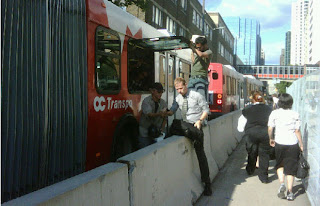
I love this. A photo printed in the Ottawa Citizen last week, a few riders bailing out in the midst of insane traffic- and construction-related slowdowns. Obviously a little undesirable from an operator perspective, but I certainly can't blame any of these riders for making their own exit. I guess, depending how loosely you define it, this could be seen as a emergency...

Tuesday, July 27, 2010

Voluntary census could hurt transit policy-making

The debate surrounding the federal government's decision to revoke the mandatory participation in the country's long-form census is all over the news, and seems to be growing. Although this website isn't the place to get into detail about the debate (read this article for a run-through), but it's worth noting that some critics think making the process voluntary will negatively impact the development of certain programs, including transit and transportation.

Tim Weis, the director of renewable energy and efficiency policies at the Pembina Institute, an Alberta-based environmental research group, said public transit agencies that want to plan new services, routes or incentives for commuters, also benefit from answers to questions on the long-form census that ask people how they get to work.

"When you're looking at programs for energy efficiency or programs for public transportation, some of the things you need to know are the sizes of houses, how they're living in them and how they're getting to work," said Weis.
It is fairly straightforward to see how this would happen, at least if we assume that people won't fill out a voluntary census as eagerly as they would a mandatory census. The city of Ottawa, for instance, is targeting a 30% modal share in public transit users, a statistic readily available in the federal census. Establishing benchmarks for transit policies as well as measuring the city's progress against those benchmarks will, in all likelihood, suffer is the mandatory census is made voluntary.

Monday, July 26, 2010

Smiths Falls looking into commuter transit

The Town of Smiths Falls and Lanark Community Transit (LCT) are working on putting together an arrangement to offer commuter transit for residents of the town, according to the Kemptville EMC.
A Carleton Place-based and managed not-for-profit organization, LCT has been offering bus service to and from Ottawa since May 3. And now, if it is feasible, it would like to expand that service to neighbouring Smiths Falls.
The LCT currently runs a return trip from Carleton Place to Ottawa four times in the morning, and runs the opposite route for the evening. Spacing Ottawa had a great article about "The Green Corridor", as it's called, back in May.

Friday, December 19, 2008

Alternative public transit: Car-sharing

I had never heard of car-sharing programs until I recently came across an article in the Halifax, Nova Scotia-based Chronicle-Herald. The idea, basically, is communal shared ownership of a number of cars coordinated by a managing body. Members make an annual payment plus an hourly rate when they use the car (in Halifax's CarShareHFX program, it is $250 annually, plus $10/hour for peak times or $3/hour for down-times. The fees are all-inclusive, covering fuel, insurance, and maintenance, and are charged directly to a credit card. According to the article, it's a successful system in some cities:
"The effect on congestion, parking and emissions can be spectacular. CommunAuto, Montreal’s car-share service — the first one in North America — reckons that 250 cars in its fleet take 3,500 cars off the road.

"In fact, car-sharing has become so mainstream that green property developers in cities like Ottawa are including car-share memberships in the amenities of their condos, and providing space for car-share vehicles to park right inside the building. Some foresee a day when the developer’s obligation to provide parking will be sharply reduced for buildings that incorporate car-sharing in their design."
According to the Wikipedia page on the phenomenon, there are more than six hundred cities globally that have some form of car-sharing program, including Ottawa's Vrtucar program. According to Vrtucar's official website, "You have 24-hour access to a fleet of cars stationed conveniently in Ottawa neighbourhoods." There are several different pricing plans for people with different needs, so check out the website if you've got any interest.

And if you're a reader from outside the Ottawa area, or you're travelling somewhere else, you can see a listing of cities with available car-sharing programs at CarSharing.net. For many people, the arrangement would be both cheaper than owning a car, less difficult, and better for the environment. And it offers another possibility for transportation, especially as the city's transit strike continues to drag on.

Thursday, December 18, 2008

Commuters: Patience is a virtue

The Sun reports today in a small news hit that commuters had a pretty smooth ride to work today, but that it won't last long:
A snowstorm expected to dump up to 10 cms on the region overnight is to be followed by another, more substantial, snowfall on Sunday. Total accumulations -- including the 10 cm which fell on Wednesday -- could be in the 40-50 cm range, and strong winds are expected to whip the snow around creating poor visibility.
Get this, though. The Citizen is being quite a bit more sensational than its print-media counterpart in a story headlined "Weather watchers warn of 'snow-mageddon'":
Wednesday morning was commuter hell in Ottawa and across much of southern Ontario, but it may have just been a warm-up for the “snow-mageddon” headed our way as two new storms fix their sights on the province.
Be patient, commuters. It could be a long few days.