Showing posts with label Mike Maguire. Show all posts

Monday, September 27, 2010

2010 Election: Maguire on walking and cycling

Over the course of the 2010 Mayoral Election campaign, Public Transit in Ottawa will be sitting down with as many mayoral candidates as are available, discussing their platforms and thoughts on transit in this city, and what they hope to achieve during their mandate, if elected mayor.

In discussing forms of 'active transportation', at least in terms of walking and cycling, mayoral candidate Mike Maguire would be more than happy to encourage people to use these types of transportation. But he does caution that, in his mind, there has to be a limit to what is offered to cyclists in order to ensure building cycling infrastructure doesn't do undue damage to business interests.
There has been an enormous focus on things like bike lanes downtown. I read this material, I think it was the Somerset BIA who just had a question from council about putting in a substantial bike-lane system, and their comment resonated with me—unfortunately it doesn’t resonate with council—their comment was, “You’re going to kill our businesses. We need areas to park; if the cars don’t come here, nobody buys our stuff.” There’s a limit to the generosity available out of any given body of people, and at the municipal level, we’re way past the limit of our generosity.
Maguire has mentioned that should his commuter-rail transit alternative move forward, it would result in fewer cars and less congestion in the city's core--which would then create more space and more safety for cyclists at street level.

Recap of the mayoral debate on the environment

The first ever Ottawa mayoral debate on the environment took place at Saint Paul University on Sunday night, and there was no shortage of... excitement for those in attendance.

Fireworks started right off the bat, when candidate Jane Scharf questioned the fairness of the questions participants were to be asked, and withdrew from the debate. This opened up a spot for candidate Andy Haydon (who hadn't responded in time to be an official member of the debate), but he declined the opportunity--but still joined into the debate, informally and periodically. Candidate Joseph Furtenbacher was also in attendance, but because he hadn't responded in time to become an official candidate (he said he wasn't invited, possibly because he joined the race late) [Ed. note: Mr. Furtenbacher contacted be to explain that he wasn't invited to the debate because invitations were sent out prior to his registration as an official mayoral candidate], he wasn't invited to participate, and simply sat in the seat vacated by Scharf--without participating.

And all that excitement was before the debate had even officially started.

Over the course of the debate, a large number of environmental issues came up, from protecting aquifers and sensitive ecological areas to water management to 'smart growth' and urban planning. Although no question was directly asked about public transit, it did come up periodically, and there was a significant discussion about cycling in Ottawa.

As for public transit, candidates spoke up about their plans. Incumbent Larry O'Brien spoke about his support for the current plan, as did Jim Watson; Mike Maguire and Clive Doucet each briefly mentioned their alternative transit plans; Andy Haydon very briefly mentioned his support for expanding Ottawa's BRT system, and called Ottawa's transit system Canada's best (citing ridership per capita to support his claim); and Robin Lawrance one again expressed his concerns for public safety with regard to the plan to build a tunnel. The only other speaker given an opportunity were César Bello--who didn't discuss transit plans, but did say he'd ensure no more transit strikes--and Charlie Taylor, who didn't speak much to public transit in general (but has in the past expressed grudging support for the city's current transit plan).

As I write this post, hours after the debate, I'm still not sure what to think about what I just witnessed. There were some good points made, but they were rare gems hidden in the personal attacks and ideological statements and slogans that dominated the debate. And, as was pointed out by Taylor, the whole thing was dominated with 'greenwashing', and many of the candidates were definitely speaking to the audience in front of them.

Still, the debate can be seen as nothing but a positive thing for this city. There were a couple hundred people in attendance (it was standing-room only by the time it started), and most of the audience were very interested in what was said. In terms of getting the environment on the radar for the mayoral race, as well, the event was a huge success.

Good news for those of you who missed the debate, but want to watch it: It will be on Rogers 22 in Ottawa this Tuesday, Sept. 28, at 8:30 p.m. Tune in, if you can; you won't be sorry.

Monday, September 20, 2010

2010 Election: Maguire on the hub-and-spoke system

Over the course of the 2010 Mayoral Election campaign, Public Transit in Ottawa will be sitting down with as many mayoral candidates as are available, discussing their platforms and thoughts on transit in this city, and what they hope to achieve during their mandate, if elected mayor.

Mayoral candidate Mike Maguire has had a number of ideas to reorganize OC Transpo, and this idea is no difference: Maguire calls for less rural service, and a true hub-and-spoke system for the organization.
We serve kind of a modified hub-and-spoke system right now. One of the things that we introduced ourselves, as a municipality, that probably hasn’t served us all that well, was to insert almost a competing bus service: We operate an express route, as well as normal, standard pick-up routes. Again, I’m quoting from my colleagues who are transit experts, they tell me that operating a parallel express and normal-run services is not only expensive, it’s not very efficient. Bottom line, for us, I think you need to look at, starting at the very minimum, the outlying extremities of Ottawa. Bus service through Manotick, for instance, through Richmond, parts of Goulbourn, Munster-Hamlet; having OC Transpo do that route is a terrible idea, because OC Transpo has to do—I hesitate to say they get to do—OC places a surcharge on every property within the catchment area when they do rural pickup.
What Maguire is proposing is an elimination of express routes, which would be unnecessary if his GO Ottawa commuter rail proposal was supported, anyway. The commuter rail system may seem like a "competing" service to OC Transpo in the same way express buses are, but Maguire would still have suburbs served by routes like the 95, 96, and 97.
I have no reason to believe they wouldn’t run. Right now, the people who are taking the 95 or the 96 in Barrhaven are doing so because it meets their needs, and I presume they’ll continue to do so. We want to get the guys in their cars off the road, the guys who say, “I can’t spend 40 minutes on a bus, make three transfers, and end up 12 miles from here.” That’s the kind of person we want to entice.

Friday, September 10, 2010

2010 Election: Maguire on privatization

Over the course of the 2010 Mayoral Election campaign, Public Transit in Ottawa will be sitting down with as many mayoral candidates as are available, discussing their platforms and thoughts on transit in this city, and what they hope to achieve during their mandate, if elected mayor.

Many different ideas have come up to fix the perceived service problems at OC Transpo over the course of this municipal election, from a new transit commission to an essential-service designation. Mayoral candidate Mike Maguire, too, has an idea: Privatization of the service, or at least of some parts of it.

Maguire sees the size of OC Transpo as ineffective, and a big reason for some of the service problems that have been seen. And he thinks that by breaking it up into smaller, independently-managed pieces, some or all of those issues can be adequately addressed:
OC Transpo, as a corporation, has probably grown beyond its effective size. Certainly, we’ve seen a number of different indicators of that: Extremely low employee morale; the massive subsidy necessary; the confusing interpretation of the mandate; a $100M garage that you can’t drive the bus into. I realize that can happen, but when you’re dealing with public money, you really don’t get a second chance when you screw up like that. And that was $100M, up from $60M; that hurt, that really hurt.

I challenge the notion that we need a single bus company for the entire city. It’s contrary to common sense, and there’s no question that we need to look at privatization of routes. It comes down to money.
What his proposition would entail is a profit-sharing arrangement where a the city owns the service--both the bus services, as well as the commuter-rail "GO Ottawa" system he supports as a transit vision for the city--and the operators on it have a commission structure where their earnings are based on the service they provide.
I like the idea of owner-operator; in some way, we need to incentivize the staff who work on that to be profit-share, or part-owners. We need to break the cycle of bad labour relations at the city level, so here’s an opportunity to do something like that. We have a major issue with many of the operator grievances at OC Transpo, I think, are valid. However, we can’t possibly meet all of the demands of the operators, and yet the city has no other option at the moment. So you end up with things like that bus strike that eventually we capitulated on. And we gained nothing; nobody gained a penny on it. The operators lost money. We didn’t run a service for weeks, and we lost money; that should be impossible. And the commuters got screwed. So what was the possible value of this?

So here’s a chance to reinvent the wheel. This one, in particular. I like the idea of either a profit-sharing arrangement, or partial ownership of the service. However it’s done, the smart people will devise this later, but it can’t be the way it is.
Maguire, at the moment, hasn't yet come up with specific details on the structure or implementation of the new organization, but thinks that operators would be some of the best authorities on the subject to help design the program.
As the owner-operator, profit is your motive, not just the paycheque at the end of every two weeks. I trust in the cleverness of people to fill in the details.

Thursday, August 26, 2010

2010 Election: Maguire on OC Transpo

Over the course of the 2010 Mayoral Election campaign, Public Transit in Ottawa will be sitting down with as many mayoral candidates as are available, discussing their platforms and thoughts on transit in this city, and what they hope to achieve during their mandate, if elected mayor.

Although a big part of his platform includes an alternative transit solution of Ottawa road congestion, Mike Maguire still feels like OC Transpo will be a part of public transit in Ottawa--but he says it needs some work.
OC Transpo, as a mode of transport, in terms of the municipal service, is very inefficient. The subsidy this year is going to top $140M; well, that’s not sustainable, either. I’ll put it to you this way: Every dollar OC Transpo spends, they lose $0.50. Reducing the amount of participation in OC Transpo is not a bad thing at all, as long as you can make up a different mode of transportation that satisfies the commuting needs, while at the same time—hypothetically—reducing congestion, that’s a win-win. [...] As a corporation, as a service that the municipality owns completely, there’s no possible justification for a $140M-a-year subsidy for OC Transpo.
Maguire's commuter-oriented diesel light-rail system would not be managed by OC Transpo, but would be owned by the city. He suggests establishing some sort of owner-operator or profit-sharing arrangement to make incentives for efficiency--but that's for another post.

Maguire suggested a full-out review of OC Transpo operations, and thinks that privatization of some routes may be necessary to make the service appropriately effective.
Where I differentiate this is the difference between mass transit and public transit. OC Transpo is public transit; whether that bus is empty or full, you still pay for it. Mass transit, for example, is Howard Bus Lines going through North Gower. Or the Laidlaw bus service going through Manotick; the Osgoode Flyer has been going through Manotick for 30 years, it’s cheaper than OC Transpo, and it gets you downtown 20 minutes faster. The big advantage there is if you take the Osgoode Flyer from the Manotick Public School to Parliament Hill, your neighbour doesn’t have to pay a surcharge. And it’s still cheaper. So why wouldn’t you do that, basically, in as many places as you can find a niche to exploit? The purpose of the excercise here is mass transit: We want to get people where they want to go, as efficiently as possible, as inexpensively as possible, and if that means not supporting a billion-dollar corporation like OC Transpo, so be it. OC is supposed to serve the people, not the other way around.

Friday, August 20, 2010

Cancelling tunnel would mean cancelling project: Cullen

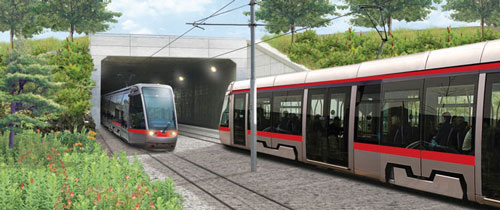
An artist's rendition of LRT trains emerging from an overpass. © City of Ottawa

The Ontario government accepted the environmental assessment for Ottawa's new light-rail transit plan--downtown tunnel included--so cancelling the tunnel, according to current transit committee chair Alex Cullen, would bring transit planners back to the square one.

From the Ottawa Citizen:

"Bay Councillor Alex Cullen, who is running for mayor, on Wednesday took a shot at anyone questioning the need for a tunnel, saying a significant change to the project would mean redoing the environmental assessment, and more public
consultation and background studies — something that took council four years to complete for its current project.

[...]

"Deputy city manager Nancy Schepers, who’s in charge of transit, said cutting the tunnel would mean the city would have “to go back to the drawing board” on its transit plan. Looking at another option, such as surface light-rail, would require figuring out how the system would work with different traffic volumes, Schepers said."
A few of Ottawa's mayoral candidates have talked about cancelling or changing the transit plan. Jim Watson is the only one who seemed interested in trying to cut the tunnel out of the plan, and he hasn't said much about it recently. Mike Maguire and Clive Doucet want completely different plans, so it makes sense that cancelling the tunnel would bring Ottawa back to square one. Charlie Taylor seems resigned to moving forward with the current plan, although he's said he'd have chosen something else if it wouldn't cost the city so much time. Stan Pioro seems interested in cancelling public transit in any measure, aside from buses to Richmond. Both Larry O'Brien and Alex Cullen want to move forward with the plan as it is today.

But for some reason, Metro Ottawa's story on the issue--and Cullen's quote about the tunnel being a 'dead issue'--is titled "Feasibility of tunnel an issue". Go figure.

Wednesday, August 18, 2010

2010 Election: Maguire on LRT affordability


Over the course of the 2010 Mayoral Election campaign, Public Transit in Ottawa will be sitting down with as many mayoral candidates as are available, discussing their platforms and thoughts on transit in this city, and what they hope to achieve during their mandate, if elected mayor.

Although Mike Maguire doesn't feel that light-rail transit in itself isn't affordable for Ottawa, he does feel that the current electric light-rail transit plan, including the downtown tunnel, won't work for Ottawa. He's proposed his own alternative: A hypothetically cheaper, commuter-driven diesel light-rail transit system, instead.
We can’t possibly afford the downtown Ottawa tunnel. [...] The downtown Ottawa tunnel and the LRT are proposed at $2.1B, which is a class-D estimate—which is plus or minus 25 per cent; it won’t be minus—so you’re looking at, realistically, it could be as high as $2.6B; if the present estimate of work is very precise and the only variable is cost, you’re looking at $2.6B. And there’s every opportunity for that to go much higher. Certainly, in terms of large infrastructure projects in the City of Ottawa, we would normally say a factor of 40 per cent would be reasonable for cost overruns in Ottawa. Round numbers, though, I don’t want to be too unfair to council, to staff: Let’s say it’s $2.5B, so the city has to borrow $1.3B, after we get $600M from the province, $600M from the federal government, so the difference is $1.3B. So $1.3B is going to be funded through the gas tax rebate.
Above the initial construction cost, though, Maguire has concerns with operating costs. Based on an average annual operating cost at 18 per cent of the purchase price (which Maguire said was a generally accepted principle--I can't really confirm or deny it), Maguire suggested operating costs for the electric LRT system would be in the range of $4-500M per year.
If you look at it operationally; as monumental as the purchase price is, operationally, it will exceed that in seven years. So yes, $2.5B is a whack of money, but within less than a ten-year period, that will be distant cousin to what we’re going to spend operationally. We don’t have that kind of money.

Tuesday, August 10, 2010

2010 Election: Maguire's transit alternative

Mayoral candidate Mike Maguire's alternative transit plan, in green, compared to the city's official transit plan, in red.

Over the course of the 2010 Mayoral Election campaign, Public Transit in Ottawa will be sitting down with as many mayoral candidates as are available, discussing their platforms and thoughts on transit in this city, and what they hope to achieve during their mandate, if elected mayor.

Of the many candidates running for mayor in Ottawa's 2010 municipal election, perhaps none have come up with as radical a transit alternative for Ottawa as Mike Maguire. His proposition, in essence, boils down to scrapping the current electric light-rail plan, and instead focusing on commuter-oriented diesel light-rail along existing rail routes from Ottawa's biggest suburbs. The grand total would be 60 km of track, which Maguire claims can be had for $215M.

Given the significant difference between Maguire's number and that we typically hear for rail-based transit plans, I was (perhaps understandably) sceptical when I spoke with him to discuss his transit plan. But Maguire maintained that his numbers are industry standard, and are based on the advice of local transportation--and particularly rail--experts:
The [financial] numbers that you see come from, in many cases, individuals who advise CN and CP on rail replacement and things of that nature. The operational costs come from comparing the model I’m using, which is based exactly on GO Transit in Toronto—which is why I’m calling it “GO Ottawa”—so their exact model, with parallel services and parallel numbers. [...] So I had managed to boil this down over four months, and we ended up with a number, very ballpark-ish, what I thought was reasonable, and then I added that huge contingency. Just in case I’m wrong, I don’t say double it, but almost add half again and say no matter what it is, it will be less than this.
The low price, according to Maguire, comes from the fact that diesel light-rail is not as costly as other forms, and the use of existing rail rights-of-way:
The advantage of diesel light-rail is that it’s extremely affordable. And we have a surprising network of rail rights-of-way all around the city. It’s really interesting to see where rail used to run, and the rail rights of way are still there.
The plan (which you can see in the image at the top [click to enlarge], in green, compared to the city's current electric light-rail plan, in red) includes rail lines from Kanata, Orleans, Barrhaven, and Osgoode/Riverside South into Bayview or downtown along the Nicholas Transitway. His plan would have little in the way of rail for downtown, and those within the Greenbelt would continue to use buses for public transit. The diesel light-rail trains, in Maguire's plan, would be commuter lines that run Monday to Friday at morning and evening peak periods.

The emphasis on suburban commuters, for Maguire, came from his observations of congestion; namely, that the majority of it is on the Queensway and arterial roads, so that is where the city should focus on addressing first.

Maguire's plan would be to implement the system in phases, and believes it could be completed within one term of council--in other words, by sometime in 2014.