Showing posts with label Hurdman Station. Show all posts

Friday, December 6, 2013

Ottawa's upcoming $72M investment in transit-oriented development

According to the Ottawa Citizen, the City of Ottawa is budgeting to spend about $72M in order to provide adequate water, sewer, road, and electrical services to three east Ottawa Confederation Line stations in order to enable the level of transit-oriented development that city staff are envisioning around the light rail stops.

The stations included in this $72M investment (as I'd like to think of it) are Lees, Hurdman, and Blair. The biggest price tag within that overall envelope is an estimated $25M to improve cycling infrastructure around and connecting to the stations, which seems like a wise concept that might allow people living and working in the area to forego personal automobiles in favour of cycling and transit (and, if the visions of progressive citizens become reality, bike- and car-sharing when necessary).

From the Citizen:
Lees, on the edge of the University of Ottawa campus, needs the least work: a mere $11 million, much of that in upgraded electricity service.
Hurdman, just across the Rideau River but practically isolated with fields on three sides (thanks to its location amid old closed landfills), needs the most: $35 million, with sewer pipes making up $15 million.
Blair, much farther east, needs $26 million worth of work, and the single biggest chunk of that is $13 million to improve the almost nonexistent bike routes to and from a station that’s tucked between the Gloucester Centre mall and a Highway 174 overpass.
I consider this a $72M investment, rather than an expense, because of the long-term benefits that would come as a result of encouraging higher-density and less car-dependent living around transit stations, and it seems likely that development charges around these stations may be able to recoup some of the costs. It's good to see the city putting money where their mouths are when discussing transit-oriented development, and hopefully developers and businesses also recognize the benefits of building in the vicinity of major rail stations.

Wednesday, December 4, 2013

Assaults most common at Billings Bridge, Blair stations

According to a report compiled by OC Transpo at the request of the Ottawa Citizen, there were 100 reported assaults that special transit constables responded to so far in 2013. Billings Bridge Station topped the list of reported assaults at or near a station with eight, while Blair was second with seven.

From the Citizen:
The figures include all types of attacks and many women’s groups say the latest figures confirm there is not enough public reporting of incidents when they occur and not enough special constables to target problem areas.
“There have clearly been more assaults than the ones reported publicly,” said Julie Lalonde, director of Hollaback, the Ottawa chapter of the international group that aims to improve street safety for women. “The only people who gain from the secrecy are perpetrators.”
Just last week, I wrote about the need for OC Transpo (and the city in general) to do more to prevent assaults on or near public transit stations and vehicles, including sexual assaults. If people are to use public transit, they need to be safe and they need to feel safe.

One way to make riders safer is to design safer transit stations. Although the City of Ottawa is talking the talk when it comes to safety-first station design, I wrote a few months ago about how that hasn't been reflected in their plans for Confederation Line stations.

More to the point, though, is the fact that there are many transit stations in Ottawa that have very obvious design flaws that, at best, make the feel unsafe and may in fact make them actually unsafe. Included in this category are Blair, Hurdman, and Lincoln Fields--all of which, to no one's surprise, were among the stations at which assaults have most commonly occurred. They're also all stations that have been cited by concerned riders because of their isolated locations.

Re-building the city's poorly designed transit stations may not be feasible right now, but it's clear that something needs to be done to treat the symptoms even if we can't cure the disease (more special constables, better lighting, increased promotion of programs in place, and so on).

More concerning, though, are the failures of this city to accept the role design plays in making spaces safe or unsafe and ensure that new stations are truly built with safety in mind.

Tuesday, December 3, 2013

Confederation Line & O-Train fare barriers to be tested in 2016

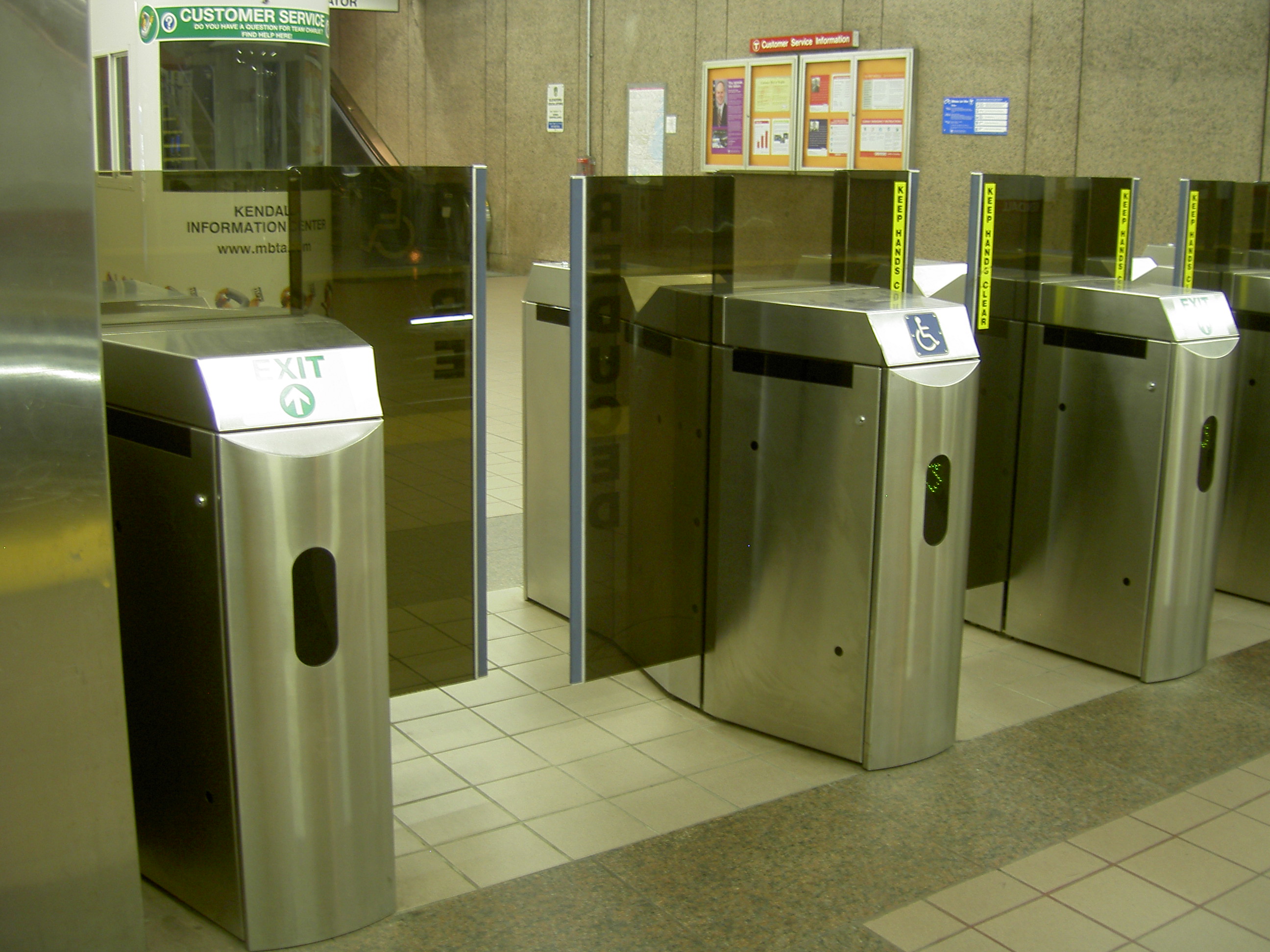
Fare gates at an MBTA station in Boston. (Dan4th Nicholas/Flickr)

As part of a new fare "control strategy", OC Transpo recommends the installation of fare barriers at Confederation Line and O-Train stations. In a report to be debated at the Transit Commission meeting next week, the implementation of fare-related equipment including fare gates, fare vending machines, and customer service communication posts, is estimated to cost between $20 and $25 million.

Physical fare barriers at O-Train stations, which are to be sheltered with "weather-protected enclosures", will be tested in 2016 before the Confederation Line opens. The decision between automated gates and turnstiles has not been made yet. The advantage to automated gates is that anyone can go through them including those who use wheelchairs or strollers.

In addition to acting as fare collectors, fare gates can be used for crowd control purposes like on Canada Day or during an emergency. The plan is to have them monitored and controlled by OC Transpo control centre. The remote ability to lock the gates is useful when there is an expected or unexpected service shutdown, for example. No one wants to pay their fare only to find out that train service isn't running.

With this method of fare collection, there is no need for POP (proof-of-payment) checkers on board any train. While it's not stated in the report, double-deckers and articulated buses will presumably continue to be inspected under the POP system.

Monday, December 2, 2013

Transitway stations get makeover in the form of "station domination"

If you travelled through Hurdman or Lincoln Fields Stations in November, you may have noticed the large Rogers Communications ads covering Transitway shelters and stairs. Pattison Outdoor Advertising, the agency in charge of managing ads on OC Transpo property, says the "station domination" ad campaign will end this week on December 3rd. (There's a photo of Hurdman Station blanketed in Rogers advertisements in the link.) Station domination gives a company exclusive advertising rights to a particular station for a limited time.

A passenger tweeted a photo of a set of stairs that shows the Rogers promotions at Lincoln Fields Station:


Last year, large lobsters were placed on top of bus stop shelters to promote P.E.I tourism. The conventional ads are the posters placed inside and outside buses, and on bus stop shelters. A single ad can wrap the entire exterior of buses. We are used to this on our transit system and wouldn't think twice. Now for the very first time in Ottawa, transit station shelters, walls, and floors can be covered in ads promoting the same message. Station domination is a common advertisement practice in subway and LRT stations across this country, but is generally met with public disapproval.

Some passengers may be annoyed with them, especially the telecom ones, while others may not noticed or simply don't care. When ads start to creep into areas that have remained ad-free, they usually don't go away. Station domination could appear in future Confederation Line stations, which will be far more spacious than the current Transitway stations and consequently, provide more opportunities to advertisers.

However, advertising on transit property is not a significant source of revenue for OC Transpo. Advertising on transit shelters and vehicles generates approximately $3.3 million per year, a relatively small amount compared to the $218.6 million revenue that the the transit agency estimates it will generate in 2014. It's roughly 1.5%. As for revenue from station domination, in 2011, the City projected it would bring $50,000 in revenue during the first year (2011) of implementation. It's nowhere near enough to stop annual fare hikes unfortunately.

Whether you like it or not, station domination is probably here to stay. There is concern about multiple ads of similarity interfering with wayfinding signage and confusing the casual user or tourist. And of course, station domination can turn a beautiful rail station into a marketing jungle. The first set of ads haven't created a public outcry, but it doesn't mean they are accepted either. Like the bus wraps, station domination should be applied sparingly.